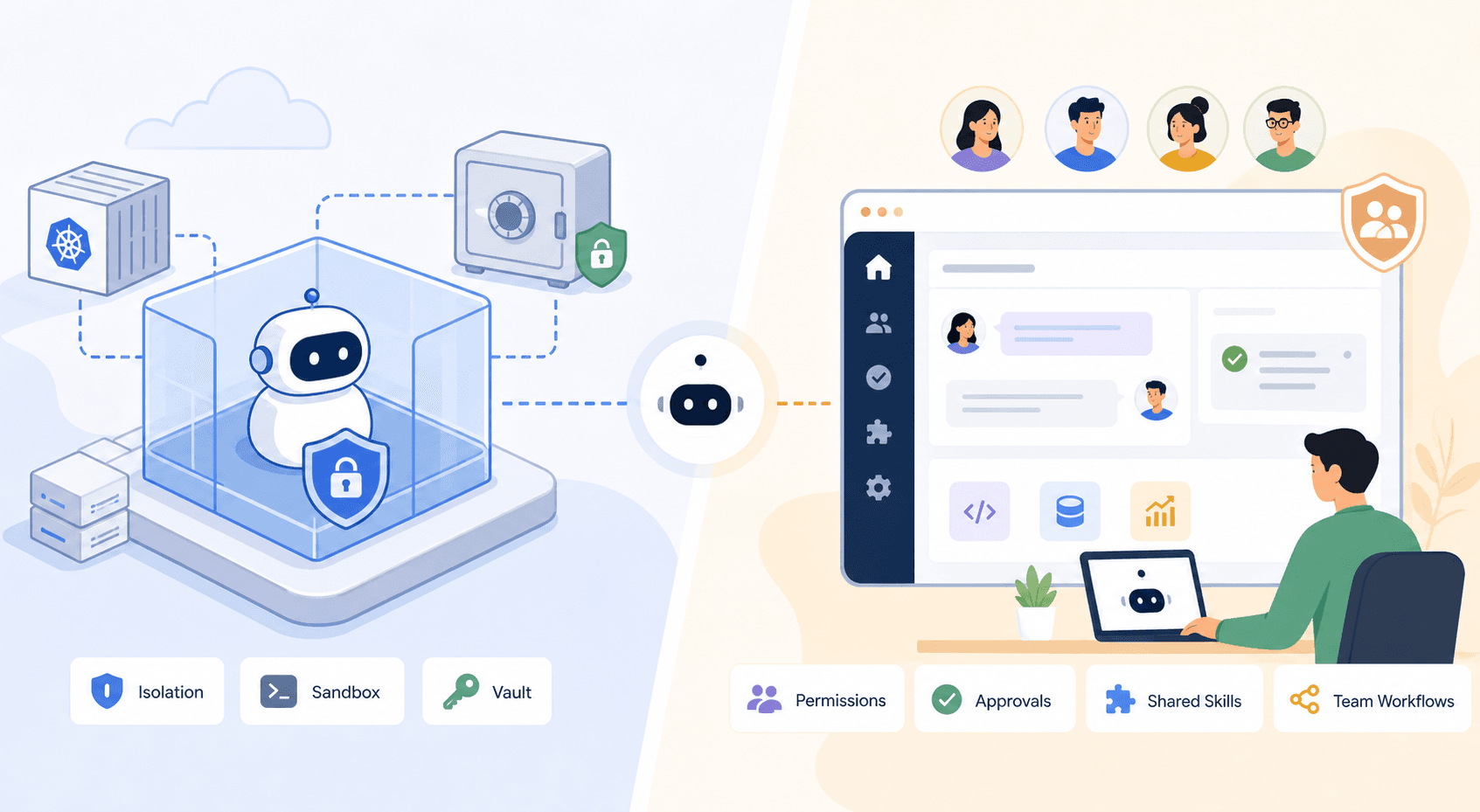
The release of LiteLLM Agent Platform is interesting because it highlights a problem that more teams are finally taking seriously: agents need a real runtime boundary.
LiteLLM Agent Platform is built around isolated sandboxes, session continuity, and a vault sidecar that keeps real credentials out of the agent process. That is a serious infrastructure answer to the question of how to run agents safely in production.
TeamCopilot is solving a different layer of the stack. It is not trying to be a sandbox scheduler or a Kubernetes runtime. It is trying to be the shared team agent experience on top of that kind of infrastructure: one setup, permissions, approvals, shared skills, workflow execution, and a web UI your whole team can use.
So the real comparison is not "which one is better?" It is "which layer of the agent stack are you trying to buy?"
The short version
| Area | LiteLLM Agent Platform | TeamCopilot |
|---|---|---|
| Main job | Run agents in isolated sandboxes | Give teams one shared AI agent |
| Core focus | Runtime safety and session continuity | Permissions, approvals, and reuse |
| Deployment model | Kubernetes-first, self-hosted infrastructure | Self-hosted team agent platform |
| Secrets model | Vault sidecar swaps stub creds for real keys | Secret proxy keeps raw secrets out of chat history |
| User experience | Infrastructure and agent runtime oriented | Team chat UI plus approved skills and workflows |
| Best fit | Platform teams building agent infrastructure | Teams that want governed day-to-day agent use |
What LiteLLM Agent Platform is really for
LiteLLM Agent Platform is designed for the part that happens after you decide agents are real software, not just a prompt in a notebook.
Its docs are very clear about the problem it solves: agents are stateful, containers restart, sessions get lost, and teams need isolated environments with different tools and different secrets. The platform answers that with per-session sandboxes, persistent sessions, and a vault proxy that only swaps stub credentials for real values at the wire level.
That makes it a strong choice when your main concern is infrastructure discipline.
If you are a platform team, you care about things like:
- where the agent runs
- how the sandbox is isolated
- how secrets are injected
- what happens when a pod restarts
- how you manage runtime dependencies
LiteLLM Agent Platform is built for that audience.
What TeamCopilot is really for
TeamCopilot starts from a different question: what does it look like when a whole team uses one agent safely?
The answer is not just a sandbox. It is a shared agent setup with permissions, approvals, auditable chat history, custom skills, workflows, and a web UI. It is built so people can reuse the same controlled agent experience without every person maintaining their own setup.
That matters because most teams do not just need an execution environment. They need a way to control who can do what, and to make sure useful agent behavior spreads across the team instead of staying trapped on one developer's machine.
If you are trying to support real team adoption, you care about things like:
- which users can run which tools
- who approves a new skill or workflow
- whether secrets ever reach the model context
- how to inspect past runs
- how to make the agent useful for more than one person
That is TeamCopilot's lane.
Where they overlap
Both products are responding to the same basic reality: agents are moving out of toy demos and into real work.
Both care about security. Both are self-hosted. Both are trying to prevent the old pattern where an agent gets broad access and everyone hopes for the best.
That is also why they can sound similar at first glance. But the similarities stop once you look at the layer each product owns.
LiteLLM Agent Platform is about the runtime boundary. TeamCopilot is about the team boundary.
The practical difference
If you adopt LiteLLM Agent Platform, you still need to decide how your team should actually interact with agents. You still need governance around who can use what, how shared tasks are approved, and how a non-technical teammate gets access to a safe agent experience.
If you adopt TeamCopilot, you are getting that team layer directly. You are not starting from scratch, but you are also not trying to build the sandbox layer yourself.
That is why this is less of a product fight and more of a stack question.
One product helps you run agents safely. The other helps your team use agents safely.
Who should choose what
Choose LiteLLM Agent Platform if your team is building internal agent infrastructure and wants Kubernetes-based isolation, session persistence, and vault-level secret handling.
Choose TeamCopilot if your team wants a shared agent that is governed, reusable, visible, and usable from a browser with approvals and permissions built in.
If you want a simple way to remember it:
- LiteLLM Agent Platform is the runtime
- TeamCopilot is the operating layer for people
Why this comparison matters
The market is getting clearer.
We are moving past the stage where "AI agent platform" meant one vague idea. Now there is a growing split between infrastructure products that make agents runnable and team products that make agents adoptable.
That split is healthy. It means teams can choose the layer they actually need instead of buying a giant stack when they only wanted safer shared usage.
For TeamCopilot, that is the point. The product is built so teams can use AI agents without every workflow turning into a custom infrastructure project. If your team already has the runtime side handled, TeamCopilot gives you the governance and shared experience on top.
And if you are still thinking about the runtime side, LiteLLM Agent Platform is a useful signal about where the ecosystem is heading.
FAQ
Is LiteLLM Agent Platform the same kind of product as TeamCopilot?
No. LiteLLM Agent Platform is infrastructure for isolated agent runtime. TeamCopilot is a shared team agent platform with permissions, approvals, and workflows.
Can TeamCopilot replace LiteLLM Agent Platform?
Not really. They solve different layers of the stack. TeamCopilot focuses on team usage and governance, while LiteLLM Agent Platform focuses on the sandbox and runtime layer.
Which one is better for non-technical teams?
TeamCopilot. It is designed around a browser-based shared experience with permissions and reusable skills.
Which one is better for platform teams?
LiteLLM Agent Platform. It is built for teams that want to manage isolated sandboxes, secrets, and session continuity on Kubernetes.
Do both products care about security?
Yes, but in different ways. LiteLLM Agent Platform focuses on runtime isolation and vault-based credential swapping. TeamCopilot focuses on permissions, approvals, masked secrets, and keeping raw secrets out of chat history.
What is the simplest way to think about the difference?
LiteLLM Agent Platform helps you run the agent safely. TeamCopilot helps your team use the agent safely.
Support the project
If this was useful, star TeamCopilot on GitHub.
TeamCopilot is a shared AI agent for teams with centralized context, permissions, and workflows.