Agent gateways are having a moment. For once, the hype is pointing at something real.
AI agents do not just answer questions anymore. They call tools, hit APIs, move data, and sometimes take actions in production systems. Once that happens, you need a gateway layer between the agent and everything it touches.
Recent industry moves show how quickly this is moving. Palo Alto Networks acquired Portkey to add AI gateway controls to Prisma AIRS, while Nutanix launched its own Agent Gateway for governance and cost control. Meanwhile, AAIF brought agentgateway under open governance, and Arcade expanded its governed agent runtime to AWS and Azure marketplaces. These different approaches point to the same conclusion: the control layer is no longer optional.
What an agent gateway does
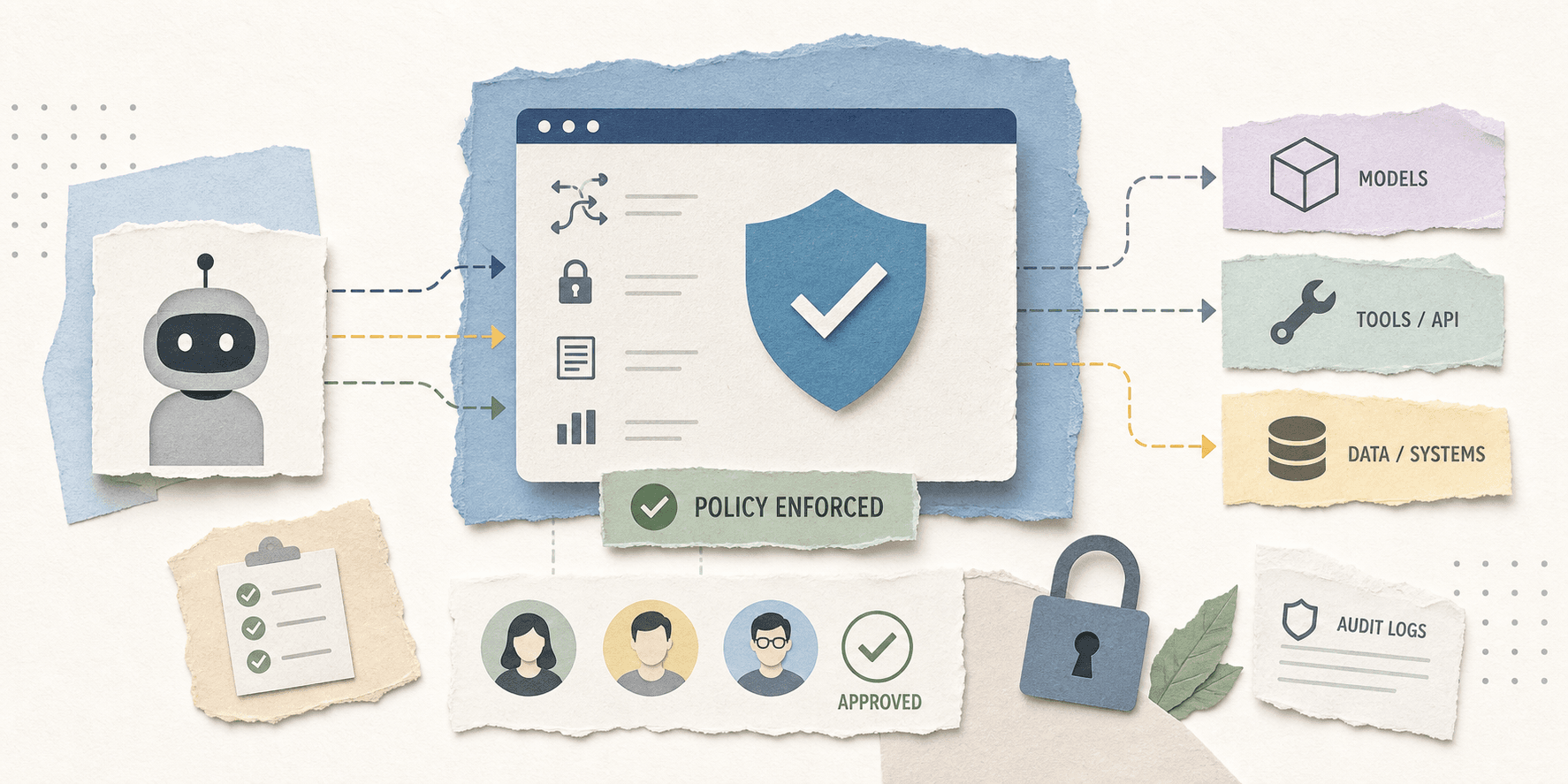
An agent gateway sits between the agent and the tools or models it uses. It can route requests, enforce permissions, limit access, record activity, and make sure the right policy is applied before anything happens.
That may sound like standard infrastructure work. It is. But it matters more for agents because agents are not passive. A chatbot can suggest. An agent can act.
Once you let software take action on your behalf, the old architecture starts to break down. You do not just need a model endpoint. You need a system that identifies the requesting agent, verifies its access permissions, and checks if a human needs to approve the step. It must also log activity for audits and provide a kill switch if something goes wrong. The gateway layer turns raw agent capability into something an enterprise can actually govern.
Why this is showing up now
This shift is happening because the market has moved past toy demos. Teams are connecting agents to GitHub, Slack, Stripe, internal APIs, databases, and deployment systems, which is where the real risk lives.
While drafting text carries minimal risk, allowing an agent to open pull requests or trigger workflows introduces real danger.
The Forbes article points to several vendors moving in this direction, including Nutanix, Arcade, Manufact, and open projects like agentgateway. The details differ, but the direction is the same. Everyone is trying to answer a single question: how do you keep agents useful without letting them roam freely?
There is also a clear split in how the market is answering that question. While some vendors aim to own the entire control plane within a larger security platform, others prioritize an open, portable gateway so teams can carry it across models, clouds, and runtimes. That tension is going to shape the category for a while.
That question shows up in our earlier post on AI Agent Governance Is the New Enterprise Control Plane because that is really what this category is becoming. A gateway that actively enforces policy matters more than one that simply routes data.
Why enterprises care
Enterprises do not buy AI because it is clever. They buy it to save time, reduce manual work, and fit into existing operations. But that only works if the system is predictable enough to trust.
Agent gateways help by reducing shadow access and making it easier to separate read and write actions. This gives security teams a central place to enforce policy, while finance teams gain visibility into token spend.
A lot of agent cost problems are really control problems. If every workflow can call the most expensive model all the time, the bill grows fast. A gateway can route work to cheaper models, block wasteful calls, or stop runaway loops before they eat budget.
The same idea appears in MCP vs Skills: Why Skills Save Context Tokens. The goal is simple: each layer should be smaller, cheaper, and easier to control than the one before it.
The market is still messy
The category is still being defined. Vendors approach the problem from various angles, including infrastructure, authorization, security, and open platform layers. This variety makes sense, because the same buyer can be looking at the problem from several angles at once.
The open-source angle is especially interesting. A neutral gateway layer could become the place where teams standardize how agents connect to tools, regardless of model provider. That would be a big deal for organizations that do not want their whole operating model tied to one vendor.
At the same time, the market is full of overlap. The line between agent gateway, agent harness, identity layer, and control plane is still fuzzy. That is not a bug. It is what early categories look like before the naming settles.
For teams comparing options, our post on Best AI Agent Platforms for Teams in 2026: Comparing 13 Tools is a good companion read, because the gateway is only one piece of the stack.
What teams should do now
If you are building or buying agent systems, do not start with the biggest model or the longest prompt. Start with control.
Ask these questions first:
- What can the agent access by default?
- Which actions require approval?
- Where are secrets stored?
- Can we log every action and decision?
- Can we revoke access quickly if something breaks?
- Can different teams use the same system without stepping on each other?
Those questions sound basic, but they are where the failures happen.
This is also where Human-in-the-Loop AI Agents: Approvals, Permissions, and Audit Trails becomes practical instead of theoretical. A gateway without approvals is just a fancier connector. A gateway with approvals and audit trails becomes part of an actual operating model.
And if your agent can ever see raw credentials, read Why Your AI Agent Should Never See Your API Keys before you go any further.
If you are designing the system from scratch, a shared workflow layer like teamcopilot.ai can save you from rebuilding the same guardrails every time. You get approvals, permissions, and reusable automation in one place instead of stitching them together per project.
Where teamcopilot.ai fits
teamcopilot.ai is built specifically to address these control and workflow challenges.
Instead of just running agents, teamcopilot.ai lets teams control who runs them, what they can touch, and when a human needs to step in. That is the difference between a demo and a workflow that belongs in production.
If you want a shared team system where workflows, approvals, permissions, and secrets are part of the design from the start, teamcopilot.ai gives you that layer without forcing every team to invent it from scratch.
That matters because most teams fail during the handoff between a smart model and a real action. teamcopilot.ai is useful there because it makes the handoff explicit.
The bigger point
Agent gateways are interesting because they mark a shift in what people think AI infrastructure is.
At first, the race was about model quality. Then it was about context. Then it was about tools. Now it is about control.
This shift is healthy. Enterprises do not need agents that can do everything. They need agents that do the right things, in the right way, under the right rules. That is exactly where the gateway comes in.
FAQ
What is an agent gateway?
It is the control layer between an agent and the tools or models it uses. In practice, it handles routing, permissions, logging, policy, and access control.
Why do enterprises need one?
Because agents can act, not just suggest. Once they can call tools or change systems, enterprises need guardrails around access, approvals, and auditing.
What problem is the market actually solving?
Teams want agents that can work across tools without turning every integration into a security exception. The gateway gives them one place to enforce policy instead of spreading rules across every app.
Is an agent gateway the same as an agent harness?
While an agent harness provides the broader runtime environment, a gateway acts as the specific control point governing what the agent can reach and how traffic flows.
Is this just another name for API management?
Unlike traditional API management that focuses on service traffic, agent gateways must handle model routing, prompt context, tool calls, human approvals, token costs, and dynamic mid-run behaviors.
How does an agent gateway help with security?
It can keep raw credentials away from the model, limit tool access, enforce policy, and record what happened for later review.
How does it help with cost?
It can route work to the right model, stop repeated or wasteful calls, and make token usage visible enough that teams can actually manage it.
Does an agent gateway reduce cost?
Yes, if it is used well. Good gateways make it easier to route work to cheaper models, stop wasteful calls, and keep runaway workflows from burning tokens.
Open source or vendor platform, which is better?
It depends on the team. Teams prioritizing portability and neutrality often favor open-source options, whereas those wanting a unified, out-of-the-box governance and security suite tend to choose vendor platforms. Most enterprises will end up using a mix.
How is teamcopilot.ai different?
teamcopilot.ai focuses on the workflow layer itself: approvals, permissions, shared automation, and secrets management. It gives teams a way to run agents with guardrails instead of improvising them.
When should a team care about this topic?
As soon as an agent can do more than draft text. If it can touch data, tools, or production systems, the gateway question becomes real.
What is the biggest risk without a gateway?
Unbounded access. The agent may look helpful right up until it reaches something sensitive, expensive, or hard to undo.
What is the simplest first step?
Start by separating read-only workflows from workflows that can take action. That one split makes the rest of the design much clearer.
What should I read next?
If you want the broader context, start with AI Agent Governance Is the New Enterprise Control Plane and Human-in-the-Loop AI Agents: Approvals, Permissions, and Audit Trails. If you are thinking about the protocol layer, MCP vs Skills: Why Skills Save Context Tokens is the best next stop.
If you want the practical safety side, Why Your AI Agent Should Never See Your API Keys is still one of the most important reads in the series.
Support the project
If this was useful, star TeamCopilot on GitHub.
TeamCopilot is a shared AI agent for teams with centralized context, permissions, and workflows.