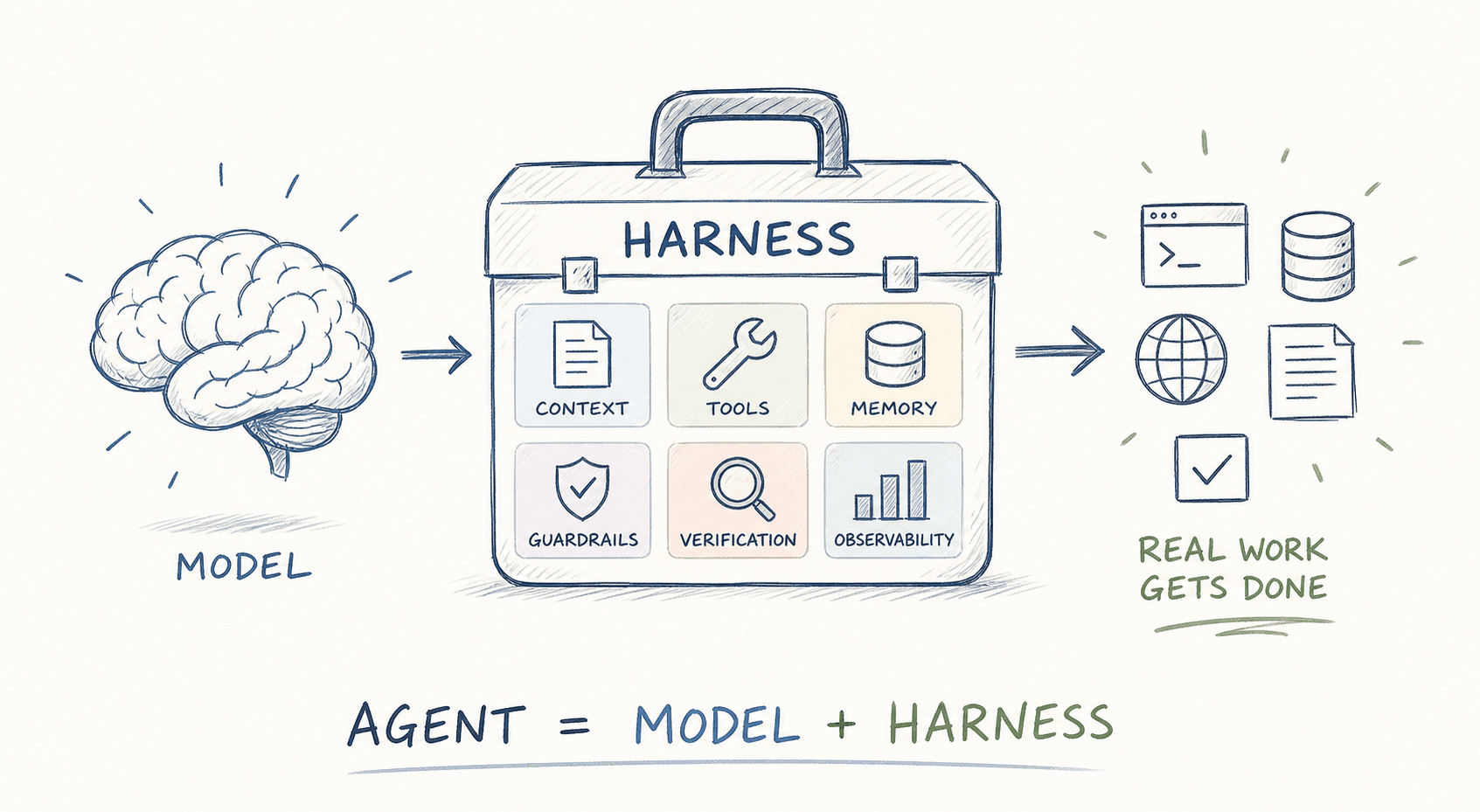
People keep using the word "harness" because it points to the part of the system that actually makes an AI agent useful.
The model does the reasoning. The harness gives it a place to run, tools to call, memory to use, and rules to follow. Strip the harness away and you usually do not have an agent anymore. You have a model that can talk.
An agent is simply a model combined with a harness:
Agent = Model + Harness
The short version
An agent harness is the software layer around a model that turns it into something that can actually do work.
It decides:
- what context the model sees
- which tools it can use
- where code runs
- what gets stored between steps
- when to ask for approval
- how to verify whether work is actually done
That is why harness engineering matters. The model is only one part of the job. The rest is the runtime around it, and most of the headaches live there.
If you want the loop itself, our post on What Is an Agent Loop? How AI Agents Reason, Act, and Iterate is the right companion read. The loop is the motion. The harness is the thing that keeps the motion useful.
Why the term matters now
For a long time, "AI" mostly meant chat. You asked a question, got an answer, and moved on.
Agent systems changed that. Now the model can read files, call APIs, run code, update tickets, and keep going across multiple steps. Once that happens, the old mental model stops working. The real question is no longer "what did the model say?" It is "what did the full system do?"
Harnesses make action possible without turning everything into chaos.
Anthropic's work on long-running agents makes this plain. Rather than dismissing models, they argue that long tasks need structure, clean state, and a way to continue across context windows. LangChain says something similar in its own harness write-up: the harness is the code, configuration, and execution logic that is not the model itself.
The industry is converging on the same idea from different angles. The model reasons. The harness makes the work real.
What lives inside a harness
A good harness is not one thing. It is a stack of small parts that work together.
Managing context
The harness decides what the model sees. That sounds minor until you watch an agent fail because it was given too much irrelevant context or not enough of the right context.
This is one reason posts like MCP vs Skills: Why Skills Save Context Tokens matter. If you keep stuffing every possible tool and instruction into every session, the agent spends energy just figuring out what is relevant.
How tools actually run
The model can suggest an action, but the harness actually runs it. This distinction matters: if the model says "run tests" or "query the database," the harness turns that suggestion into a real command, API call, or sandboxed action.
Memory and state
Real work does not fit inside one prompt. Agents need a way to remember what happened earlier, what failed, what still needs attention, and what should carry over to the next step. Without state, every new turn feels like starting over.
Guardrails and approvals
This is where the harness stops being abstract. If an agent can send money, delete files, change permissions, or touch production, you want approval gates around those steps. Our post on Human-in-the-Loop AI Agents: Approvals, Permissions, and Audit Trails goes deeper on this, but the basic point is simple: autonomy without boundaries is just risk with a nicer interface.
Verifying the output
Agents make mistakes. A harness should check the work.
That can mean tests, lint checks, policy checks, or simple validation rules. In practice, verification is what stops a confident wrong answer from becoming a shipped mistake.
Observability
If you cannot see what the agent did, you cannot fix it, trust it, or explain it later.
Logs, traces, and audit trails turn agent behavior into something a team can inspect. That is especially important once multiple people depend on the same agent.
Harness vs framework vs agent
- A model is the thing that reasons and generates output.
- A framework gives you building blocks for making an agent.
- A harness is the actual runtime behavior around the model.
- An agent is the finished system.
You can think of a framework as the parts list and a harness as the working machine.
That is why the same model can feel very different in different products. A weak harness drags down even a strong model, while a good one makes a smaller model surprisingly capable.
Why harness quality matters more than people think
Most agent failures are not dramatic. They are boring.
The agent loads too much context. It gets stuck in a loop. It uses the wrong tool. It stops too early. It takes one risky action too freely. None of that sounds glamorous, but that is where real systems break.
The best way I have heard it put is this: the model is the brain, and the harness is everything that lets the brain do something useful in the real world.
That is also why posts like Coding Agent Best Practices: How to Set Up AI Agents Securely and Productively stay relevant. A lot of the value is in the setup around the model, not the prompt alone.
Where teamcopilot.ai fits
To make an AI agent do useful work for a team, you need more than a chat box. You need permissions, approvals, secret handling, and a clean record of what happened, allowing the model to act without letting it run wild.
That is what a team harness looks like in practice. The goal is to make the model safe and structured enough that a team can actually rely on it.
What to look for in a good agent harness
If you are evaluating an agent system, look for these signs:
- it keeps context small and relevant
- it scopes tool access tightly
- it can persist useful state between steps
- it asks for approval on risky actions
- it can prove what happened after the fact
- it checks work before declaring success
- it fails in a way a human can recover from
If those pieces are missing, the system may still look impressive in a demo. It will just be fragile in production.
The simple test
You can easily tell if someone understands agent harnesses by asking them what happens after the model says, "I am done."
If they focus only on the answer, they are still thinking about chat. But if they start talking about validation, approvals, logs, state, and the next run, they understand the harness.
That is the real shift.
FAQ
What is an agent harness in simple terms?
An agent harness is the software around a model that lets it act on the world by handling context, tools, memory, safety checks, and execution.
Is an agent harness the same as an agent framework?
Not exactly. A framework gives you libraries and patterns for building agents. The harness is the actual runtime behavior that makes the agent work in practice.
Why do AI agents need a harness at all?
Models cannot run tools, keep durable state, or enforce permissions by themselves, so the harness fills that gap.
What are the most important parts of a harness?
Context management, tool execution, memory, guardrails, verification, and observability are the core pieces.
Does a better model make the harness less important?
Not really. Better models help, but they do not remove the need for control, state, approvals, and recovery.
What goes wrong when the harness is weak?
Agents get noisy, slow, unsafe, or inconsistent. They may use too much context, pick bad tools, or take risky actions without enough checks.
How is an agent harness different from a chatbot UI?
A chatbot UI mostly handles conversation. A harness handles execution. That is the difference between talking about work and actually doing it.
Where does teamcopilot.ai fit into this?
teamcopilot.ai is the kind of system that puts a harness around team workflows, so agents can work with permissions, approvals, secret handling, and audit trails.
Do I need a harness if I only use agents for small tasks?
Even small tasks benefit from basic guardrails and validation. You may not need a heavy setup, but you still need a runtime that keeps the agent honest.
What should I read next?
Start with What Is an Agent Loop? How AI Agents Reason, Act, and Iterate, then read Human-in-the-Loop AI Agents: Approvals, Permissions, and Audit Trails and Why Your AI Agent Should Never See Your API Keys.
The model provides the reasoning, but the harness is what actually gets the work done.
Support the project
If this was useful, star TeamCopilot on GitHub.
TeamCopilot is a shared AI agent for teams with centralized context, permissions, and workflows.