Prompt engineering started as a narrow craft and then grew into a much bigger idea.
At first, it just meant learning how to write better instructions so a model would give better answers. That is still part of the job. But once people started building real AI agents, the question got bigger. It was no longer just about the wording of the prompt. It became about what context the model sees, what tools it can use, what history it should remember, and how to keep all of that stable enough to run fast and cheaply. That is where context engineering comes in.
The short version
To put it directly, prompt engineering focuses on writing the instruction itself, while context engineering shapes the entire environment around that instruction. A well-written prompt gets you a better initial response, but context engineering is what makes the whole system work reliably. If you are building production workflows, this distinction directly affects quality, cost, latency, and safety.
What prompt engineering actually is
Prompt engineering is the practice of writing instructions that help an AI model do a task well. This process involves giving the model a role, defining the task clearly, adding examples, setting constraints, specifying the output format, and telling the model what to avoid.
For example, a basic prompt might ask a model to summarize a support ticket in three bullets and end with a recommended next step. A stronger prompt would add tone, audience, formatting rules, and edge cases.
Even with advanced systems, clear instructions still matter because a vague prompt wastes time no matter how good the model is. Clear instructions improve consistency and reduce guesswork. But the moment your system starts using tools, memory, retrieval, approvals, or multi-step workflows, prompt engineering alone stops being enough.
What context engineering means
Context engineering is the broader discipline of deciding what information the model should see when it runs, which includes the system prompt, user instructions, conversation history, retrieved documents, tool outputs, memory, policies, guardrails, and any hidden internal state.
Anthropic describes context engineering as the natural progression of prompt engineering, and that framing is helpful. While prompt engineering focuses on how to phrase an instruction, context engineering curates the entire set of tokens the model receives, shifting the question from how to ask something to what the model needs to know at any given moment.
Prompt engineering vs context engineering
Think of prompt engineering as the content inside the context window, whereas context engineering is the process that decides what fills that window in the first place.
Prompt engineering is still useful for single-turn tasks, classification, drafting, and clean one-off generation. Context engineering is what you need when the model has to operate as part of a system. If the model is reading docs, calling tools, remembering prior steps, or responding to dynamic data, you are doing context engineering whether you call it that or not.
This explains why the conversation has shifted. In early LLM apps, the bottleneck was often prompt wording. In modern agent systems, the bottleneck is usually context quality.
Why this matters for AI agents
Agents create context pressure very quickly. Every tool call adds output. Every retrieved document adds text. Every decision adds history. Every retry adds more tokens. Before long, the model is carrying around a lot more than the original prompt. Systems often become brittle when developers keep stuffing everything into the prompt and hoping the model will sort it out, which usually creates noise instead of clarity.
Good context engineering keeps the model's working set small, relevant, and stable.
To address this, platforms like teamcopilot.ai rely on reusable workflows and skills. If the agent needs the same procedural knowledge every time, that knowledge should not be rebuilt from scratch in every session. It should be reusable, predictable, and loaded only when needed.
KV cache changes the economics
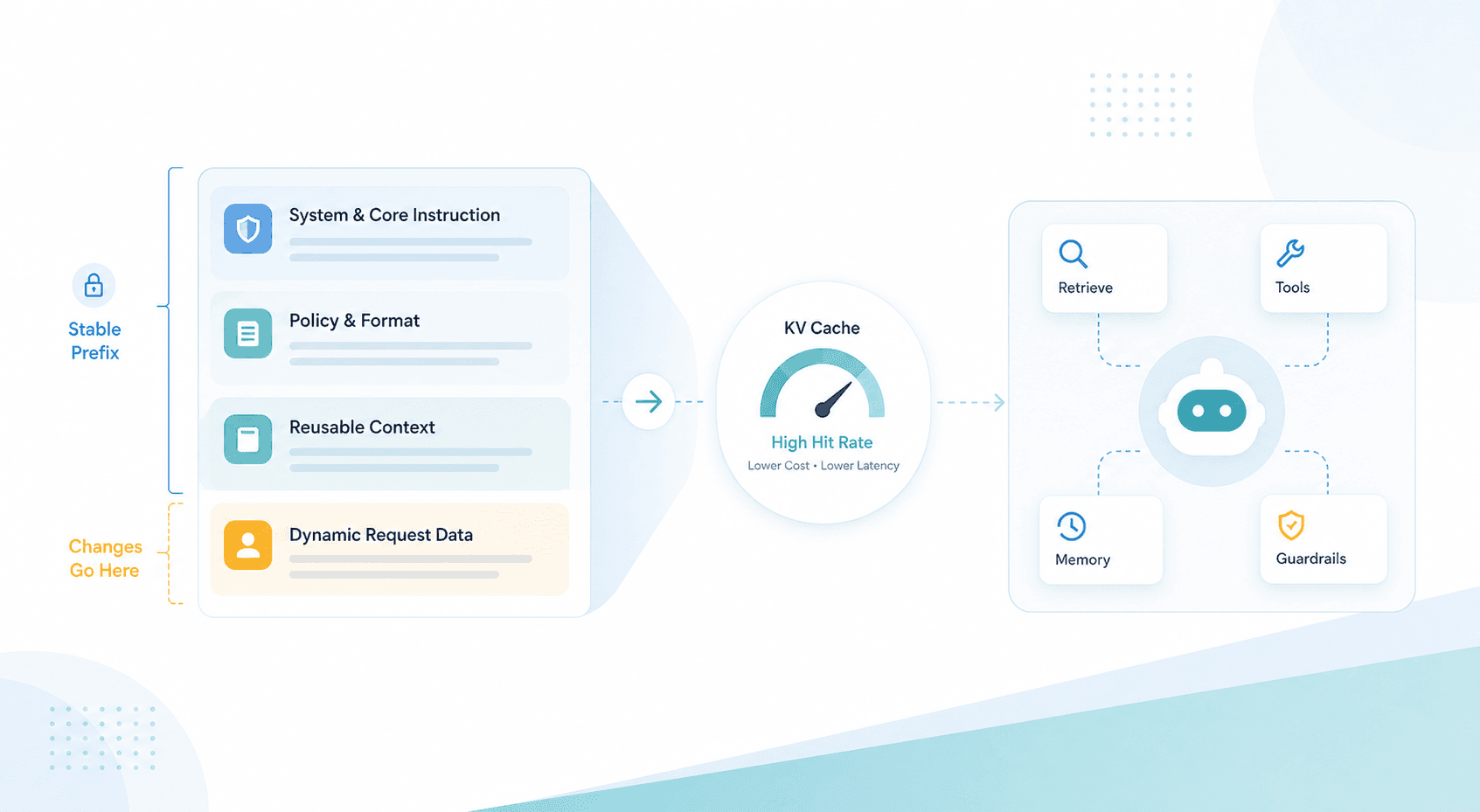
While prompt engineering focuses on wording, KV cache optimization is about structure. Modern model providers cache the internal attention state for stable prefixes, which means if the beginning of your prompt stays the same across requests, the provider can often reuse work instead of recomputing it from scratch. That matters because it reduces both latency and cost.
The key idea is simple: keep the stable part of the prompt stable. If you keep changing the system prompt, adding timestamps near the top, or inserting request-specific data into the prefix, you break cache reuse. The model then has to rebuild more of the prompt from scratch.
The practical rule: put dynamic content at the end
One of the most useful production habits is to place dynamic content at the end of the prompt whenever possible. The reason is straightforward: the more stable the leading prefix is, the easier it is for the model provider to reuse cached computation. If the early part of the prompt changes all the time, the whole prefix becomes harder to reuse.
So the general pattern should look like this:
- Start with a stable system prompt.
- Place shared instructions right after it.
- Reusable policy and format guidance should sit near the top.
- Insert request-specific data later in the sequence.
- Keep the most dynamic bits at the very end.
While prompts don't need to be identical, prioritize prefix stability over clever wording. For agentic workloads, this can make a real difference. The research and practitioner guidance around prompt caching keeps landing on the same point: stable prefixes are cheaper and faster, while dynamic data belongs later in the prompt or outside it entirely.
A better prompt structure
If you are building something real, a good prompt often has four layers:
1. Core instruction
This stable foundation tells the model what role it is playing and what overall standard it should follow.
2. Policy and format
Also kept stable, this layer includes guardrails, style, output shape, and any constraints that should remain the same across runs.
3. Reusable context
Sitting in the middle, this layer might include retrieved knowledge, a task brief, or structured memory that is relevant for a whole class of requests.
4. Dynamic request data
Placed at the very end whenever possible, this section contains the user's current request, a timestamp, a customer ID, a ticket number, or the latest tool output.
This layering helps both quality and caching. It keeps the stable prefix stable, which gives the infrastructure a chance to do its job.
What not to do
There are a few common mistakes that create needless pain. To keep your system running smoothly, avoid these practices:
- Avoid putting user-specific values into the top of the system prompt unless absolutely necessary.
- Keep JSON fields in a consistent order if the model sees that JSON as part of the prompt.
- Never bury dynamic values in the middle of a long, stable instruction block.
- Stop appending giant tool transcripts when only the latest result actually matters.
- Do not treat every request like a brand-new prompt if most of the instruction never changes.
These mistakes are small in isolation, but they quickly add up at scale.
Context engineering in practice
In a real agent, context engineering is usually about making tradeoffs. Instead of feeding the model everything, you want to select only the most relevant information, which means deciding which documents to retrieve, which memory to keep, which tool output to include, how much history to preserve, whether to summarize older turns, and what to keep out of the prompt entirely.
This is the heart of the difference between a toy demo and a production system. While prompt engineering makes a model sound smarter, context engineering is what makes it truly useful.
How teamcopilot.ai fits in
This is exactly the sort of problem teamcopilot.ai is built to help with. When teams are running reusable workflows, they usually want the instructions to be consistent, the risky steps to be gated, and the context to stay manageable. That is much easier when the system is designed around reusable skills, permissions, and controlled execution instead of one-off prompts scattered everywhere.
If you want a related read, MCP vs Skills: Why Skills Save Context Tokens is a good companion post. It covers the same basic idea from another angle: less unnecessary context, more deliberate reuse.
You may also like Human-in-the-Loop AI Agents: Approvals, Permissions, and Audit Trails and Why Your AI Agent Should Never See Your API Keys. Those posts are really about the same production problem: keep the agent useful, but keep the dangerous parts under control.
A simple production checklist
If you are building an AI workflow today, use this as a quick check:
- Keep your system prompt stable.
- Put dynamic data at the end of the prompt.
- Strip out anything the model does not need.
- Summarize old context instead of endlessly appending it.
- Retrieve only the most relevant information.
- Separate instructions from data.
- Use approvals for high-risk actions.
- Reuse skills or templates when the same procedure repeats.
That checklist is not fancy, but it works.
The deeper lesson
The real shift is that prompt engineering has evolved from phrasing into systems design.
Building agents that read, retrieve, act, and iterate means designing an information flow rather than just writing prompts. Deciding what enters the model, when, and how consistently is what defines context engineering. And when you care about latency and cost, it also becomes cache engineering.
Related reading
- What Is an Agent Loop? How AI Agents Reason, Act, and Iterate
- Human-in-the-Loop AI Agents: Approvals, Permissions, and Audit Trails
- MCP vs Skills: Why Skills Save Context Tokens
- Why Your AI Agent Should Never See Your API Keys
- Coding Agent Best Practices: How to Set Up AI Agents Securely and Productively
FAQ
What is prompt engineering?
Prompt engineering is the practice of writing instructions that help an AI model do a task well. It covers role setting, examples, constraints, and output formatting.
What is context engineering?
Context engineering is the broader job of deciding what information the model should see, including prompts, memory, retrieved data, tool output, and policy.
Is context engineering replacing prompt engineering?
No. Prompt engineering is still part of the job. Context engineering just expands the scope to include the whole environment around the prompt.
Which matters more for AI agents?
Context engineering usually matters more for agents, because agents depend on retrieval, tool use, state, and repeated steps. A good prompt helps, but good context keeps the system usable.
Why does prompt structure affect KV cache?
Because caching works best when the prefix stays stable. If you keep changing the beginning of the prompt, the provider has less reusable computation.
Should dynamic data always go at the end of the prompt?
Usually, yes. If the data is request-specific, placing it near the end helps preserve a stable prefix. There are exceptions, but this is a strong default.
What counts as dynamic data?
This includes timestamps, request IDs, user-specific details, session state, latest tool output, and other values that change often.
What should stay stable in a prompt?
Your role instruction, policies, formatting rules, and reusable task guidance should stay as stable as possible.
Does prompt caching always help?
It does not always help, but it is most effective when a large chunk of the prompt repeats across requests. If every prompt is unique and short, the benefit is much smaller.
What is the biggest mistake teams make?
They overstuff the prompt with everything they know. That hurts clarity, weakens caching, and makes the model carry more context than it needs.
How does this apply to AI workflows?
Use a stable instruction layer, keep dynamic inputs separate, and make the workflow reusable. That is a much better foundation than one giant prompt copied around by hand.
How does teamcopilot.ai help here?
teamcopilot.ai helps teams build reusable AI workflows with shared instructions, permissions, and controlled execution. That makes it easier to keep context consistent without turning every prompt into a one-off experiment.
What is the difference between prompt engineering and prompt caching?
Prompt engineering is about making the instruction effective. Prompt caching is about making repeated prefixes cheaper and faster to process.
Is context engineering just retrieval augmented generation?
No, retrieval is only one part of it; context engineering also includes memory, tool outputs, policies, history management, and what you intentionally leave out.
What should beginners focus on first?
Start with clear prompts, then learn to separate stable instructions from dynamic inputs before moving on to retrieval, memory, and caching.
What is the simplest rule to remember?
Keep the stable stuff stable, and put the changing stuff at the end.
Support the project
If this was useful, star TeamCopilot on GitHub.
TeamCopilot is a shared AI agent for teams with centralized context, permissions, and workflows.