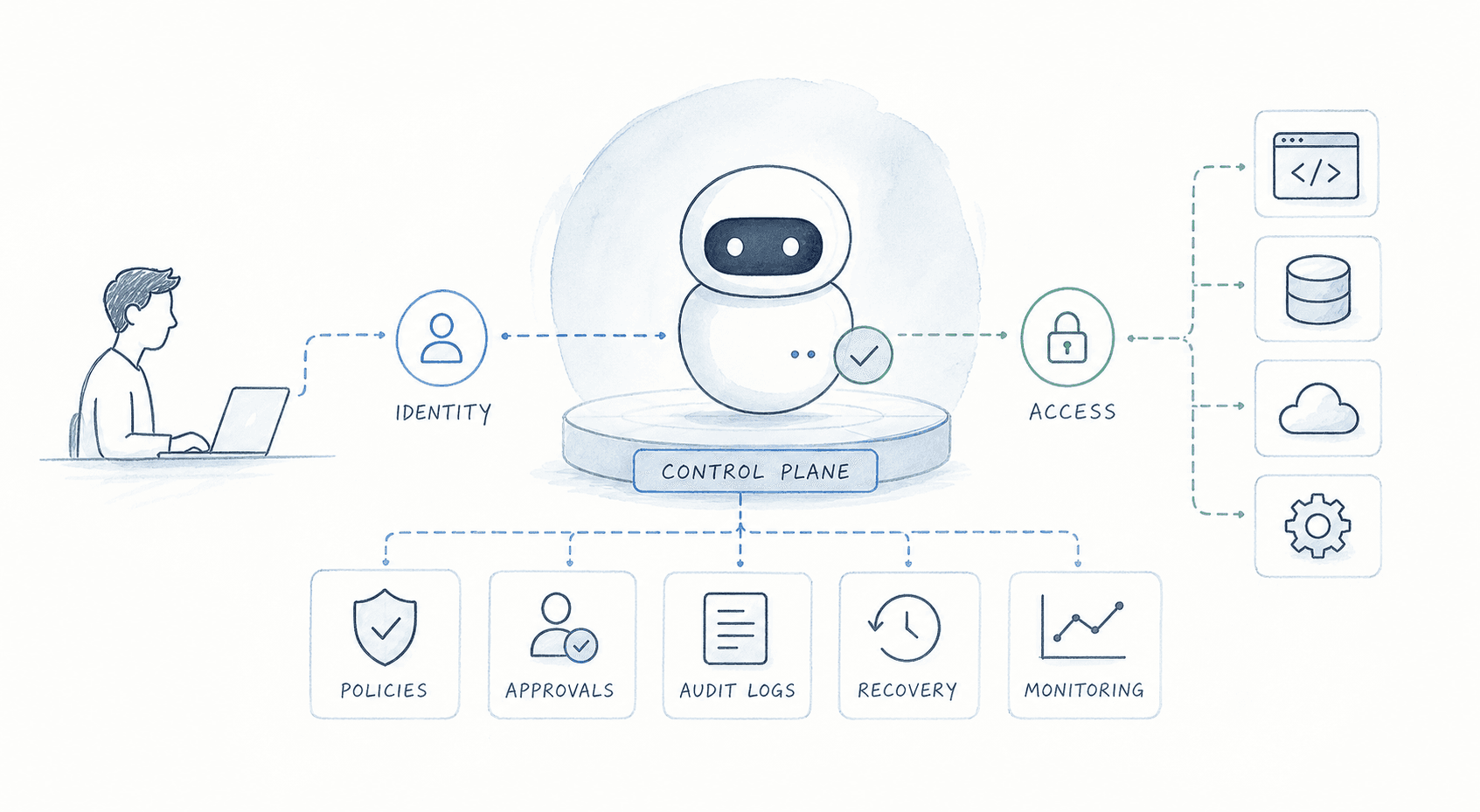
AI agents are becoming active identities within your tech stack, not just software features. Once an agent can read data, call tools, and trigger workflows, the idea of a simple chat assistant disappears. You are buying control over an autonomous actor with access to your systems.
As a result, AI budgets are shifting quickly. Security teams now focus on ownership, access limits, tracking, autonomous action thresholds, and emergency shutdown procedures.
Why identity is the real story
The newest AI security guidance keeps circling the same ideas. Treat agents as first-class identities. Limit autonomy. Use strong identity management. Keep a record of what each agent can access. Plan for failure.
This has become the default operating model for agentic systems.
Recent coverage has made the shift obvious. Dark Reading reported that AI agent projects are forcing enterprises to rethink identity budgets because agents need visibility, fine-grained access, governance, and lifecycle management. Infosecurity Magazine made the same point from another angle: many organizations are already using agents for sensitive security work, but they are still underprepared for recovery and control when credentials or permissions go sideways.
The real challenge is securing the identity layer around the model.
The budget line has moved
In older software projects, security was often treated as a later add-on. Buy the tool, deploy it, and then bolt on controls if needed.
That approach breaks with agents.
Useful agents are inherently risky. An assistant helping with code review might accidentally edit the wrong file or expose secrets while inspecting a repository. Any agent that opens browser sessions or calls APIs immediately expands your attack surface.
With agents, the budget follows the risk.
Teams end up paying for things that used to be optional or invisible:
- inventory and discovery of agent identities
- least-privilege access models
- approval steps for risky actions
- secret handling that keeps raw credentials out of model context
- audit logs and traceability
- rollback and recovery paths
- policy enforcement across teams
That is why identity security is becoming its own budget line. It is not overhead. It is the operating cost of running agents safely.
The lesson from the broader market
This theme is showing up everywhere.
CISA and its partners recently published guidance on careful adoption of agentic AI. The message was simple: limit autonomy, use layered defenses, and do the identity work properly. The UK NCSC said something similar in its own guidance on securing agentic AI use. The language is converging. Start small. Apply cyber hygiene. Plan for failure.
That lines up with what we are seeing in the market more broadly. Akamai's acquisition of LayerX and other secure browser moves point to the same truth: the browser is becoming a control point for AI usage. Palo Alto Networks' Idira launch points to the same thing from the identity side: human, machine, and agent identities are starting to blur into one governance problem.
The product category is not just "AI tools" anymore. It is control around AI tools.
Why this matters for teams, not just security leaders
Teams need a practical way to run agents safely without turning every workflow into a security exception, rather than building a massive platform from scratch.
Agents must be scoped by team and task; a research agent should not have the same reach as a deployment agent.
Secrets should never be handed directly to a model. If an agent can see raw keys, it can leak them through accidents or prompt injection, as we detailed in Why Your AI Agent Should Never See Your API Keys.
Useful agent behavior must also be reusable. When one person builds a safe workflow, the rest of the team should be able to adopt it without repeating the security review.
That is the gap TeamCopilot is built for. It gives teams one shared agent experience with permissions, approvals, secret handling, and workflow control, so the agent can be useful without becoming loose in the system.
The governance pattern is now familiar
The more you look at recent AI security stories, the more the same pattern appears.
OpenAI's Daybreak launch showed how serious security workflows are moving toward controlled, validated execution. Our earlier piece, OpenAI Daybreak: AI-Powered Vulnerability Detection and Patch Validation, focused on that shift. The lesson was not just that models can do more, but rather that access, approval, and validation become critical once they do.
The same idea appears in AI Agent Governance Is the New Enterprise Control Plane. That post argued that the real battleground is no longer model quality alone, but instead identity, permissions, audit logs, workflow control, and recovery.
If agents are becoming first-class identities, governance is no longer a side concern, but the product boundary.
What good AI agent governance looks like
If you are trying to get this right, the checklist is not mysterious. It is just easy to underfund.
- Give every agent a distinct identity.
- Scope access by team, environment, and purpose.
- Keep secrets out of the model context.
- Require approval for actions that can change systems or data.
- Log the important tool calls, not just the final answer.
- Track where agents exist and what they can do.
- Make revocation and recovery fast.
- Revisit permissions when the agent changes.
That last point matters because agents drift and workflows change over time; a safe setup in March can easily become a liability by May.
What this means for the next year
Successful teams will be those that can deploy AI repeatedly without creating chaos.
That usually means one of two paths. Either a company builds a heavy internal platform to manage agent identities and controls, or it adopts a product that already treats governance as a first-class feature.
The first path is possible, but slow. The second path is usually easier for smaller teams and faster-moving companies.
This shifts the buying decision from whether an agent can perform a task to whether it can do so safely, repeatedly, and across multiple users.
That is the real budget line.
Support the project
If this was useful, star TeamCopilot on GitHub.
TeamCopilot is a shared AI agent for teams with centralized context, permissions, and workflows.