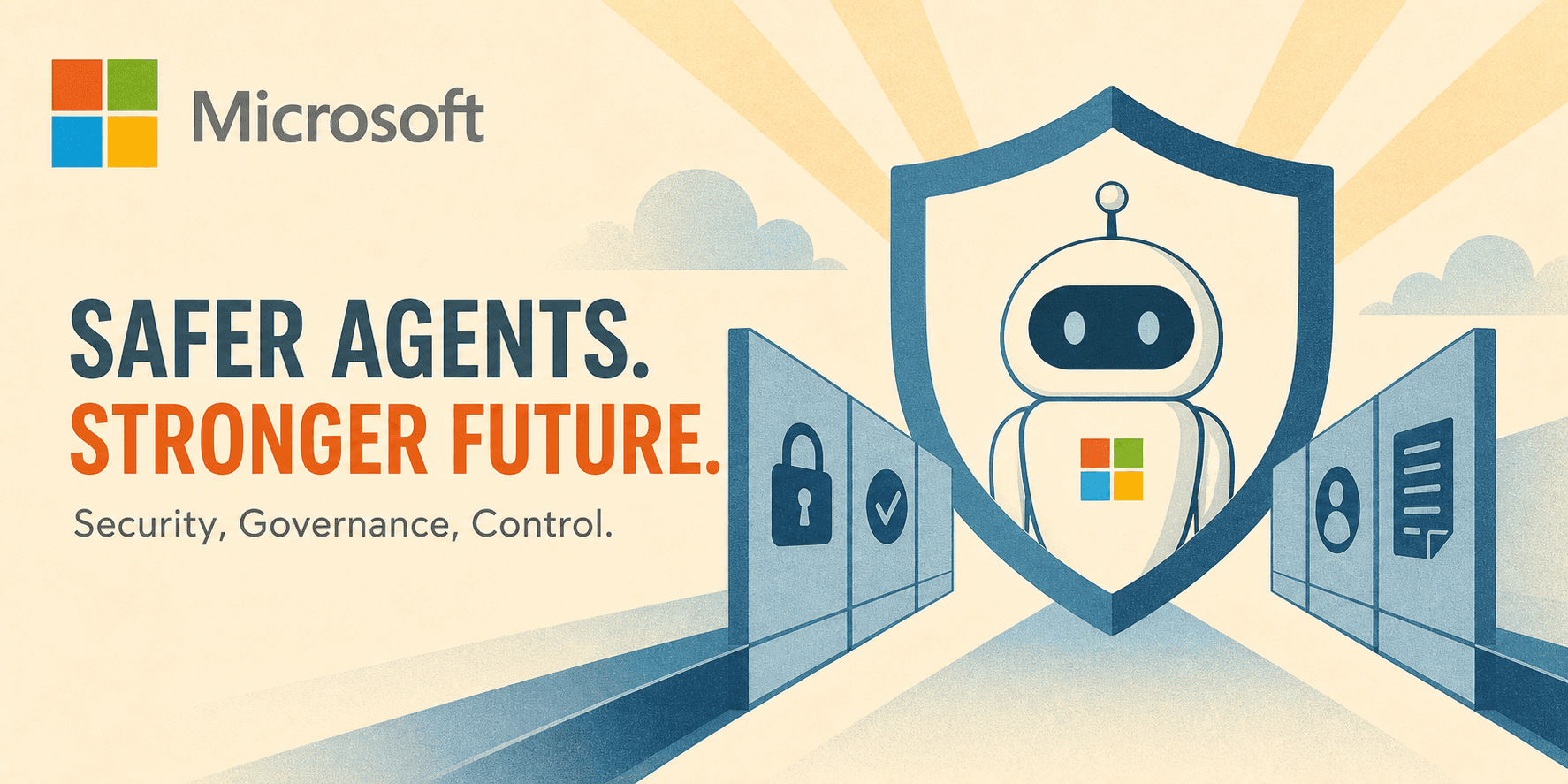
Microsoft's Build 2026 security announcements point to a shift that has been building for months: AI agents are now powerful enough to require a real security perimeter.
For a long time, teams treated agents like a nicer chat box. They let the model think, call a few tools, and hoped the system behaved. Microsoft is taking the opposite view. Its new stack assumes agents can act, drift, and touch real systems, meaning they must be contained like any other privileged workload.
What Microsoft announced
Microsoft's Build 2026 security post lays out the full picture. The main pieces are:
- MXC, a sandboxed execution system for untrusted agent code
- Agent 365 SDK, which gives developers tools to build and manage agents with control in mind
- Windows 365 for Agents, a managed environment for isolated agent workspaces
- MDASH, a multi-model agentic scanning system for discovering and validating vulnerabilities
- ACS, an open control specification for enforcing agent policy across environments
- ASSERT, a testing framework for evaluating whether agents stay within policy
Microsoft is moving from model demos to runtime control.
That is why CSO's coverage called MXC a "short leash" for AI agents. It is a good phrase because it captures the real problem. The issue is not just what the model says, but what the agent can touch after it says it.
Why this matters now
The agent security problem is bigger than prompt injection, bad outputs, or benchmark scores; once an agent can read files, call APIs, access credentials, or modify code, it becomes part of the system of record. Every tool call is a security event. Every identity, default permission, and missed audit trail matters.
TechCrunch framed Microsoft's ACS effort as a better way to control agent behavior across environments. That is the right lens, as organizations need policies that survive across frameworks, runtimes, and teams rather than just better prompts.
VentureBeat highlighted the other side of the story: the sandbox is only useful if teams can write the right policies for it. That is the hard part: most organizations are still figuring out who is allowed to run an agent, what that agent can access, and when a human needs to approve the action.
The real lesson from Microsoft
Microsoft is not just shipping a new feature set; it is defining a pattern.
This pattern starts with containing the agent at runtime and granting only the minimum necessary permissions. From there, teams must track agent activity, test whether it stays inside policy, and ensure they can easily revoke access when something changes.
The broader market is moving in this same direction. The more capable agents become, the less acceptable it is to let them operate like an ungoverned script with a chat window in front.
This is also why security and governance are now part of the buying decision. Buyers are asking whether a platform can generate code or automate work without opening a new class of incidents.
What this means for teams
Teams must treat agents as production-grade software rather than toy apps.
Teams should now expect runtime isolation for risky actions and explicit approval flows for sensitive steps. They also need secret handling that keeps raw keys away from the model, audit logs for every meaningful action, and policy controls that apply consistently across teams.
That is why posts like Why Your AI Agent Should Never See Your API Keys still matter. Secret exposure is one of the easiest ways for a useful agent to turn into a liability.
It is also why AI Agent Governance Is the New Enterprise Control Plane still feels like the right frame for the market. The winner is not just the company with the biggest model, but the one that can safely operationalize agents across real work.
And when things go wrong, the blast radius can be severe. For a concrete example, see An AI Coding Agent Deleted a Production Database. Here's What Happened and How to Prevent It.
Where TeamCopilot fits
TeamCopilot is built around the same basic idea Microsoft is now pushing into the mainstream: agents need guardrails.
That means:
- permissions instead of blanket access
- approvals instead of silent execution
- secret management instead of raw key exposure
- workflows instead of one-off improvisation
- shared controls for teams instead of isolated prompts
These guardrails are designed to let teams use agents safely without turning every workflow into a slow, manual risk review.
If you are thinking about enterprise AI in that way, TeamCopilot sits in the gap between "cool demo" and "something a company can trust." It gives teams a way to use agents while keeping the control layer visible and manageable.
For a broader comparison of the market, Best AI Agent Platforms for Teams in 2026: Comparing 13 Tools is a useful next read.
The bottom line
Microsoft's Build 2026 announcement matters because it confirms the market has moved.
The primary challenge is ensuring agents can do useful work safely, predictably, and with enough control for enterprises to trust them.
MXC, MDASH, Agent 365, and ACS are all part of that answer. So are approval systems, secret boundaries, and policy-driven workflows.
That is the future of agentic software: safer agents, not just smarter ones.
FAQ
What is MXC?
MXC, or Microsoft Execution Container, is Microsoft's sandboxed runtime for untrusted agent code. It is designed to keep agents inside defined boundaries while they run tools or perform actions.
What is MDASH?
MDASH is Microsoft's multi-model agentic scanning harness. It uses many specialized AI agents to discover, validate, and prove whether code vulnerabilities are actually exploitable.
What is Agent 365?
Agent 365 is Microsoft's control layer for observing, governing, and securing agents across environments. It is meant to help teams manage agent sprawl, risk, and policy.
Why is agent containment such a big deal?
Because agents are not just generating text anymore. They are reading data, calling tools, and taking actions. Without containment, a small mistake can become a real incident.
How is this different from normal app security?
Traditional app security assumes the software is mostly deterministic. Agents are more dynamic. They can choose actions, change paths, and interact with many tools, so they need runtime controls as well as static checks.
Does this mean every company needs its own agent platform?
Not necessarily. Most teams need a clear control layer, not a giant platform. The key is to enforce permissions, approvals, secrets, and auditability wherever the agent runs.
How does this relate to TeamCopilot?
TeamCopilot is built for the same reality. It gives teams a safer way to run AI agents with permissions, approvals, secret management, workflows, and shared governance.
What should teams do first?
Start with the highest-risk workflows. Identify where agents can touch secrets, production systems, or customer data, then add containment and approval steps before scaling further.
Is Microsoft saying agents are unsafe?
Not exactly. Microsoft is saying agents are powerful enough that safety has to be engineered into the stack. That is a much more mature position than pretending risk does not exist.
What is the biggest lesson for buyers?
Ask how the platform handles identity, permissions, runtime isolation, approvals, and audit logs. Those controls matter more than a flashy demo.
Support the project
If this was useful, star TeamCopilot on GitHub.
TeamCopilot is a shared AI agent for teams with centralized context, permissions, and workflows.