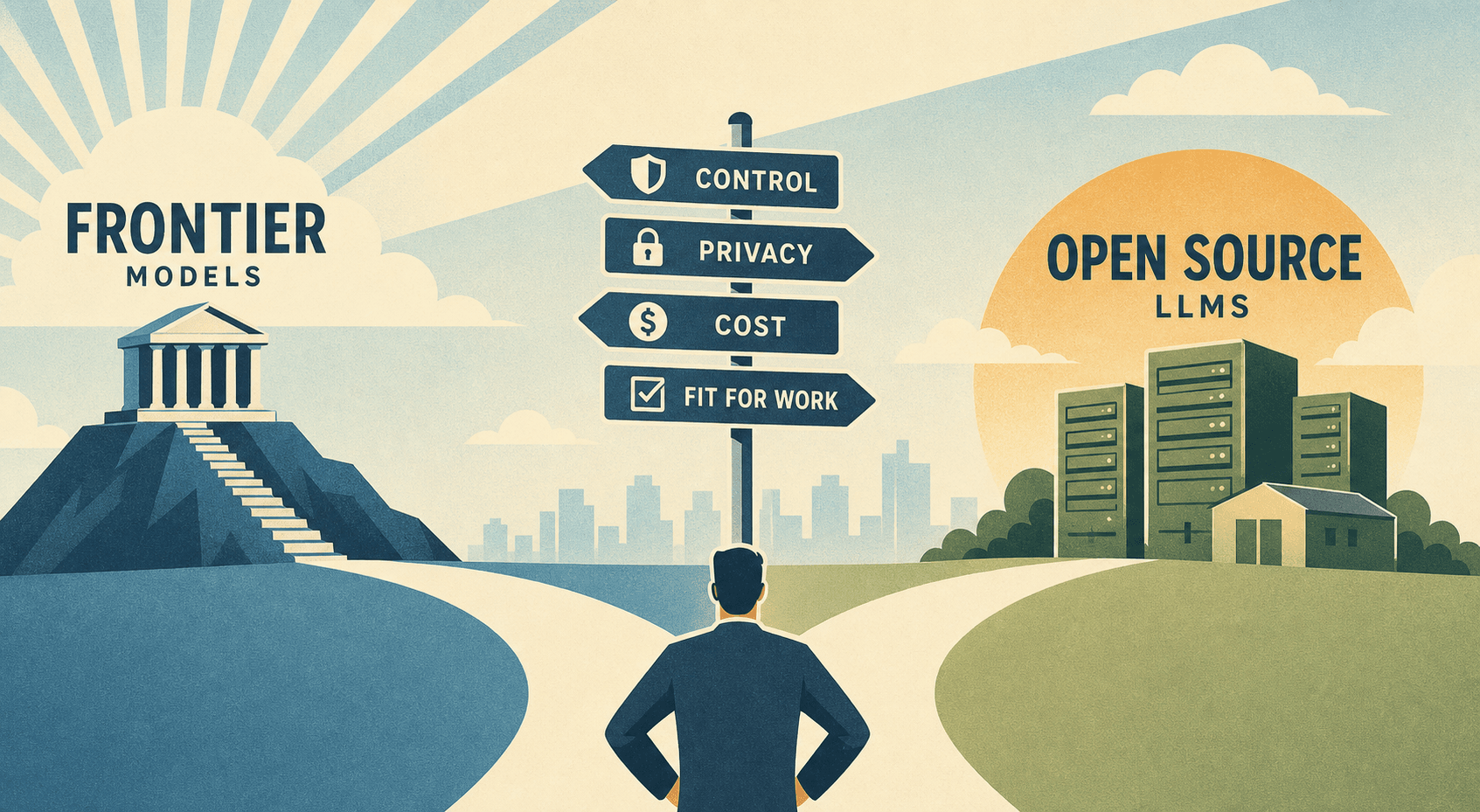
For a while, the default answer to almost every AI problem was simple: use the strongest frontier model you can get.
That made sense early on. Hosted frontier models were better at reasoning, more forgiving with messy prompts, and much easier to plug into a product than anything most teams could run themselves. If you wanted a prototype quickly, they were the obvious choice.
But enterprises do not live in prototype mode for long.
Once AI moves into real workflows, the questions change. How much does it cost at scale? Where does the data go? Can we audit it? Can we control it? Can we make it behave the way the business actually needs? Those are the questions pushing more teams toward open source LLMs, self-hosted deployments, and model tuning on their own data.
Frontier models are still useful, just not for everything
This is not a case for throwing frontier models out. They are still the right tool for some jobs.
If you need the strongest general reasoning, the best shot at a weird one-off task, or a model that can handle broad, ambiguous instructions with very little setup, frontier models are hard to beat. They also make sense when volume is low and the value of a top-tier answer is high.
But the catch is that most enterprise work is repetitive, policy-heavy, domain-specific, and sensitive, encompassing document processing, internal search, ticket triage, code review, compliance checks, sales follow-up, support routing, and workflow automation. These tasks usually do not need the most expensive model on the market. They need something reliable, cheap enough to run often, and safe enough to touch company data. That is where the frontier-model-everything mindset starts to fall apart.
Why enterprises move away from frontier models for routine work
Cost adds up fast because while a frontier model is cheap enough for occasional use, it turns into a real line item when you use it thousands of times a day across many teams. The more the workflow repeats, the less sense it makes to rent the most expensive intelligence for every step.
Beyond budget, managing sensitive data presents a major hurdle. Many enterprise workflows involve contracts, customer records, internal strategy, code, legal documents, or regulated data. Sending all of that to a third-party API is a non-starter for a lot of companies, especially when residency and retention rules are strict.
Generic models also tend to miss the local details that make enterprise work hard. They know a lot, but they do not know your schema, your product language, your approval rules, or the difference between a real exception and a normal part of your process. That is why teams often get answers that are technically fine and still not useful.
Finally, relying on a single vendor introduces operational risk. If the price changes, the API changes, the policy changes, or the product roadmap shifts, your workflow can get expensive or brittle overnight. Self-hosted and open source models reduce that dependency.
What open source LLMs change
Open source models give enterprises more control over the full stack, allowing you to run them on your own infrastructure, keep sensitive data inside your environment, and choose the model size that fits the task. Some teams might deploy a smaller model to handle classification or extraction, while others require a larger model tuned for internal knowledge or a narrow business domain.
The real advantage is fit, rather than ownership for its own sake. If you know the use case well, you can choose a model that is good enough instead of paying for a model that is better in theory but wasteful in practice. That usually means faster responses, lower cost, and fewer surprises. There is also a second benefit: you can tune the model to the business instead of asking the business to bend around the model.
Fine-tuning on your own data
For many enterprise use cases, fine-tuning is the first serious step beyond generic prompting, letting a model learn your tone, your labels, your formats, your domain terms, and your preferred decision patterns. It helps when the base model already knows the general idea but not the details you actually care about.
That is useful in a lot of places:
- support teams that need consistent response style
- legal teams that need clause classification
- finance teams that need structured extraction
- recruiting teams that need better resume ranking
- internal assistants that need company-specific terminology
The point is not to make the model smarter in the abstract, but to make it useful for a task you repeat constantly.
While RAG is great for keeping facts current, fine-tuning is better for maintaining consistent behavior, formatting, or decision style.
When RL-based training helps
While supervised fine-tuning is often enough, some problems require reinforcement learning techniques like RLHF, RLAIF, and related preference-based training methods. These approaches are useful when the model needs to learn to produce high-quality, context-appropriate answers rather than just predicting the next token.
This matters for enterprise work because a lot of business output is judged by more than factual correctness. It needs to be concise, compliant, on-brand, and action-oriented. RL-style training can help push a model toward those outcomes when plain prompting keeps drifting.
In practice, the rule is simple: use the lightest method that gets the job done.
Start with prompting. Add retrieval. Then fine-tune if the same behavior keeps showing up across many workflows. Use RL-style methods when you need the model to internalize a preference structure that simple supervised data does not capture well.
The practical enterprise pattern
Most teams do not need to replace frontier models everywhere; instead, they need a split strategy. You can deploy frontier models for complex, rare, or high-stakes tasks that justify the extra cost, while routing frequent, predictable workflows to open-source or self-hosted models. This keeps sensitive data close to home and reserves expensive API calls for the moments that actually require them.
This architecture typically follows a clear pattern:
- A smaller self-hosted model handles the bulk of routine work.
- A fine-tuned model handles a specific internal workflow.
- A frontier model is reserved for complex reasoning or fallback.
- Approvals and logging sit around anything that can take action.
That kind of architecture is boring in the best way. It is cheaper, easier to govern, and much easier to explain to security, legal, and finance teams.
Why this matters for agents
The model is only one part of an agent system.
If an agent can call tools, read documents, or trigger workflows, then the model choice matters less than the surrounding controls. That is why teams are moving from "Which model should we use?" to "Which model should do which job, and under what rules?"
For a deeper look at the control side of this shift, see AI Agent Governance Is the New Enterprise Control Plane and Human-in-the-Loop AI Agents: Approvals, Permissions, and Audit Trails.
If your team is also deciding how much context to keep around the model, What Is Prompt Engineering? A Practical Guide to Context Engineering and KV Cache is a useful companion piece.
Where teamcopilot.ai fits
teamcopilot.ai supports this deployment logic. Teams need reusable workflows, clear approvals, and a way to route different tasks to the right level of intelligence without making every employee reinvent the setup.
That matters most when some workflows can safely use a local or fine-tuned model while others should still fall back to a frontier model. A shared system makes that pattern manageable.
The bottom line
Frontier models are still the ceiling in many cases. They are just no longer the default answer for every enterprise task.
For a growing number of teams, the better answer is a mix of open source LLMs, self-hosted deployment, fine-tuning on proprietary data, and RL-based training when behavior needs to be shaped more carefully. That mix gives enterprises more control, lower cost, and a system that fits the work instead of forcing the work to fit the model.
Related reading
- AI Agent Governance Is the New Enterprise Control Plane
- Human-in-the-Loop AI Agents: Approvals, Permissions, and Audit Trails
- What Is Prompt Engineering? A Practical Guide to Context Engineering and KV Cache
- MCP vs Skills: Why Skills Save Context Tokens
- Why Your AI Agent Should Never See Your API Keys
FAQ
What is a frontier model?
A frontier model is one of the most capable general-purpose LLMs available from a major provider. These models are usually the strongest option for broad reasoning and difficult open-ended tasks.
Why would an enterprise use an open source LLM instead?
Because open source models can be self-hosted, tuned on proprietary data, and used with more control over privacy, cost, and deployment.
Are open source LLMs always cheaper?
Not always upfront; you may spend more on infrastructure and setup, but at higher volume, self-hosted models can be much cheaper than paying frontier-model API costs for every request.
When should a company still use a frontier model?
Use it for tasks that are rare, complex, or high value enough to justify the cost, or when the best possible answer matters more than control and price.
What kind of tasks fit self-hosted models best?
High-volume tasks, sensitive workflows, classification, extraction, support routing, internal search, and repetitive business processes are usually a good fit.
What is fine-tuning in this context?
Fine-tuning means training a base model further on your own data so it behaves more like your use case needs, whether that means output format, tone, labels, or domain behavior.
Is fine-tuning better than retrieval-augmented generation?
They solve different problems: RAG is better for fresh facts and documents, while fine-tuning is better for consistent behavior, style, and task-specific patterns.
When do RLHF or RLAIF matter?
They matter when you need the model to prefer one style of answer over another, or when simple supervised tuning is not enough to shape the behavior you want.
Do enterprises need to train models from scratch?
Usually not, as most teams should start with an existing open source model and then tune it for their needs.
What is the biggest mistake companies make with enterprise AI?
Using the strongest model for everything. That often creates unnecessary cost, weak governance, and a system that is harder to maintain than it needs to be.
Is self-hosting only for very large companies?
No. It used to be much harder, but modern open source models and deployment tooling make self-hosting realistic for smaller teams too, depending on the workload.
How do you decide between a small model and a frontier model?
Start with the smallest model that can do the job reliably. Move up only if quality, complexity, or failure cost makes it necessary.
What about compliance and data residency?
Those are often the main reasons to self-host. If data cannot leave your environment, open source models become much more attractive.
Can open source models handle enterprise language well?
Yes, especially when they are tuned on your own terminology, internal docs, and workflow examples.
How does teamcopilot.ai help with this shift?
teamcopilot.ai helps teams build reusable workflows with shared controls, so they can choose the right model for each task without losing governance or repeatability.
Support the project
If this was useful, star TeamCopilot on GitHub.
TeamCopilot is a shared AI agent for teams with centralized context, permissions, and workflows.