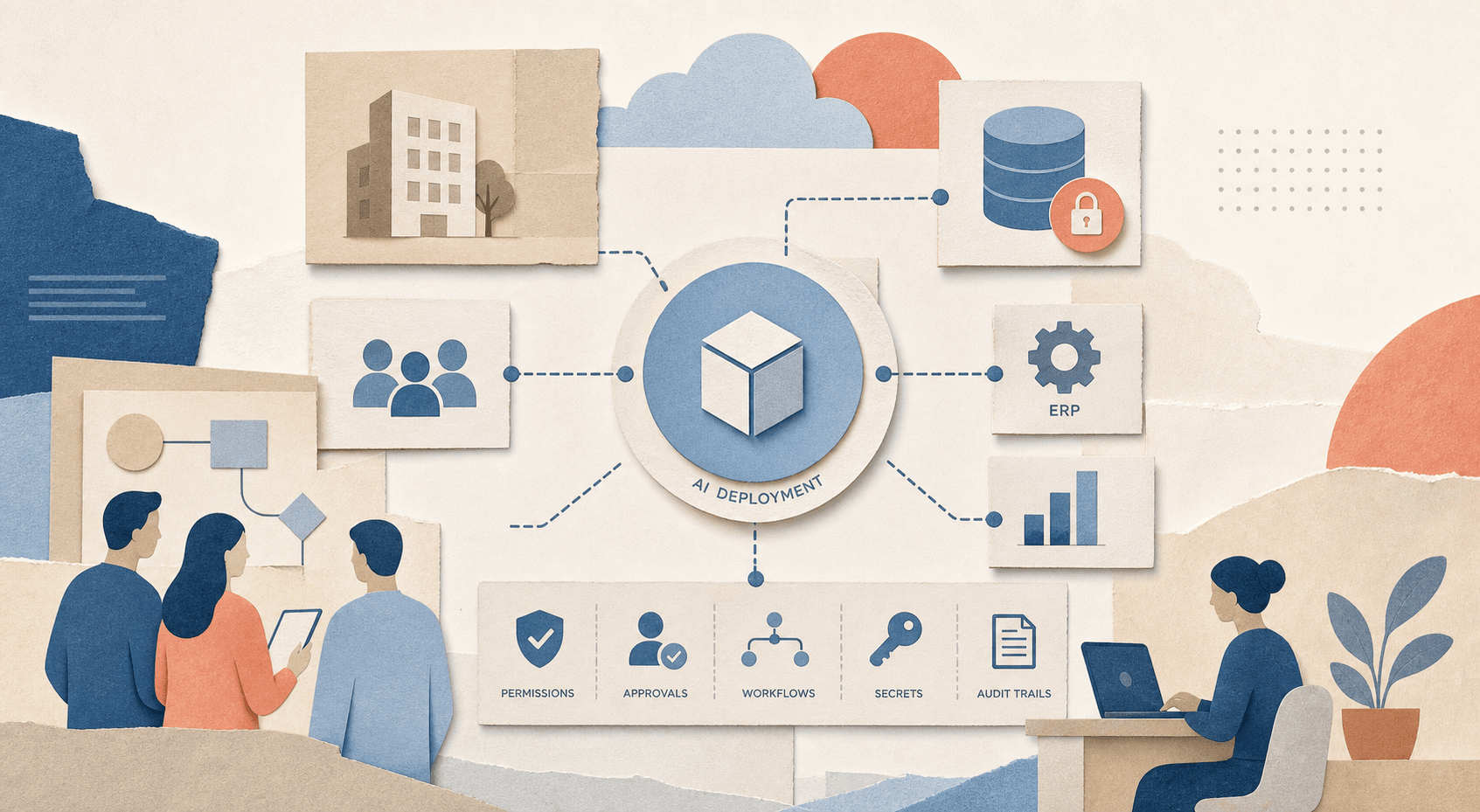
OpenAI just made a move that tells you a lot about where enterprise AI is heading.
Last week, the company announced the OpenAI Deployment Company, a new unit backed by more than $4 billion to help large organizations put AI into real production workflows. Reuters reported that OpenAI will also acquire Tomoro, an AI consulting firm, to bring about 150 deployment specialists into the new business from day one. OpenAI's own announcement framed the point clearly: the next stage of enterprise AI is not only about better models. It is about helping companies redesign workflows, connect AI to real systems, and make the results stick.
That is a bigger story than "OpenAI launched a consulting arm."
It means the market is admitting something that many teams have already learned the hard way: model quality is not the main blocker anymore. Deployment is.
What actually happened
The new unit is called the OpenAI Deployment Company. Depending on which coverage you read, it is being described as a deployment business, a services arm, or a consulting arm. All three descriptions point to the same reality.
OpenAI is building a business around implementation.
According to Reuters, the company is setting up a majority-controlled business to embed engineers specialized in frontier AI deployment into customer organizations. OpenAI's announcement says those engineers will work with operators and business teams to identify high-value workflows, redesign infrastructure around AI, and turn those changes into durable systems. Axios was even more direct and called it an AI consulting arm.
That is worth pausing on.
For the last two years, the dominant AI story was model capability. Better reasoning, longer context windows, lower latency, and lower cost all mattered. They still matter. But this move says the commercial fight is shifting. The prize is no longer only who builds the smartest model. It is also who helps enterprises actually use it.
Why OpenAI is doing this now
Because most enterprise AI projects do not fail at the prompt.
They fail somewhere between the pilot and the part where the company is supposed to rely on it every day.
The technical problems are familiar enough. Systems need to be connected. Data needs to be available. Permissions need to be mapped correctly. Agents need to know what they are allowed to touch. Teams need logging, approvals, rollback paths, and clear ownership.
But the harder part is often organizational.
Which workflow should change first? Which team owns the deployment? How do you train people to trust the system without giving it too much freedom? How do you stop a useful experiment from turning into an ungoverned mess?
That is consulting work, integration work, and change-management work. It is not the kind of problem you solve by shipping a better model and waiting for procurement to figure out the rest.
OpenAI had already been moving in this direction. Earlier this year, Reuters reported that OpenAI launched its Frontier Alliances program with consulting firms like McKinsey, BCG, Accenture, and Capgemini to push enterprise AI beyond pilots and into core business processes. The new Deployment Company looks like the next logical step. Instead of only relying on partners, OpenAI is bringing more of that deployment capacity in-house.
This is not just an OpenAI story
This is the clearest sign yet that the enterprise AI market is moving from model selling to implementation selling.
Reuters also reported earlier this month that both OpenAI and Anthropic-linked ventures were exploring acquisitions of AI services firms. The logic is simple. If model providers want more enterprise revenue, they need more people who can actually get the product embedded into a company's day-to-day work.
That is also why the idea of the forward-deployed engineer keeps showing up. The market is borrowing a playbook from Palantir: put technical people inside customer environments, learn the real workflow, and build around that reality instead of expecting a generic product to fit on day one.
This changes how enterprise buyers should think.
The question is no longer just, "Which model should we buy?"
It is closer to:
- Who is going to help us deploy this?
- How will we govern it once it is deployed?
- What internal system will keep it safe, understandable, and reusable?
The first question is where OpenAI's new unit fits.
The second and third questions are where things get more interesting.
Where the consulting model helps
To be fair, there is a real need here.
Many companies are still in the awkward middle stage of AI adoption. They have strong interest from leadership, scattered experiments across teams, and a lot of uncertainty about what should become a real production workflow. A deployment-focused services arm can help them move faster.
That model is especially useful when a company needs help with:
- identifying which workflows are worth automating
- connecting AI systems to internal tools and data
- setting up evaluations and testing loops
- training teams around new operating models
- getting an early deployment live without building everything in-house
That is real value. There is nothing fake or temporary about that need.
Where the consulting model stops
But there is an important limit to this model.
Consulting can help you get AI into production. It does not automatically give your whole organization a safe way to use AI every day.
That is a different layer of the problem.
Once the initial deployment is done, companies still need answers to questions like:
- Which users can run which agents?
- Which skills or workflows require approval?
- How are secrets handled so raw credentials never leak into the model context?
- How do teams share useful agent workflows without giving everyone blanket access?
- How do you inspect what the agent did last week when something goes wrong?
Those are not one-time implementation questions. They are operating questions.
That is why I think the deeper takeaway from OpenAI's move is not "services are back." It is that enterprises are realizing they need an AI operating layer, not just a model and not just a consulting engagement.
What this means for TeamCopilot
This is exactly the gap TeamCopilot is built for.
OpenAI's Deployment Company is about helping organizations get AI into important workflows. TeamCopilot is about what happens after that, when a real team needs to use AI safely across everyday work.
If you have already decided that agents are useful, the next challenge is not abstract. It becomes operational:
- marketing wants one research workflow
- engineering wants a coding workflow
- support wants a triage workflow
- leadership wants visibility into what is running
You cannot solve that with one giant prompt and shared API keys.
You need permissions, approvals, reusable skills, auditable runs, secret management, and a clean interface people can actually share. The secret-handling part matters more than it sounds. Why Your AI Agent Should Never See Your API Keys goes deeper on that pattern. That is why I keep coming back to the same point: the interesting product category here is not only the model vendor or the systems integrator. It is the governed team layer on top.
If you have read AI Agent Governance Is the New Enterprise Control Plane, this will sound familiar. The market keeps producing the same signal from different directions. Enterprises do not just want raw capability. They want control.
And if you have tried to roll out a tool like Claude Code across a team, the same pattern appears at a smaller scale. How to Use Claude Code with a Team makes the point in a more practical way: the hard part is not only access to a good model. It is permissions, key management, and making shared use actually safe.
The same thing applies here, just at enterprise scale.
The real market signal
OpenAI's new consulting arm matters because it reveals where the money is moving.
Not away from models, but away from the idea that models alone are enough.
The next wave of enterprise AI spending will go into deployment, workflow redesign, governance, and operational control. Some of that spend will go to consultancies and deployment teams. Some of it will go to runtime infrastructure. Some of it will go to internal operating layers that make AI usable across teams.
That split is healthy because it makes the market easier to understand.
For example, LiteLLM Agent Platform vs TeamCopilot is really a story about different layers of the stack. One side focuses more on runtime boundaries and sandboxing. The other focuses on team governance and shared use. OpenAI's move adds another layer to that picture: deployment services.
So when people ask, "What does this mean for TeamCopilot?" my answer is simple.
It is validation.
It validates the idea that enterprise AI success depends on more than model access. It depends on how AI gets deployed, governed, and shared inside a real organization. OpenAI is moving down into implementation because that is where enterprise friction lives. TeamCopilot exists because friction does not disappear after implementation. It moves into permissions, workflows, trust, and day-to-day usage.
That is the layer teams end up living with.
FAQ
What is OpenAI's new consulting arm?
It is the OpenAI Deployment Company, a new OpenAI-controlled business designed to help companies deploy AI systems into real workflows. Coverage varies between calling it a deployment company, services arm, or consulting arm, but the practical idea is the same.
Did OpenAI actually buy a consulting firm?
Yes. OpenAI announced it agreed to acquire Tomoro, an applied AI consulting and engineering firm, to add roughly 150 deployment specialists and forward-deployed engineers to the new unit.
Why is this important for enterprise AI?
Because it shows the bottleneck has shifted from pure model capability to implementation. Enterprises need help connecting AI to data, tools, workflows, and internal operating processes.
What are forward-deployed engineers?
They are engineers who work closely inside customer environments to help design, implement, and adapt technical systems around real business workflows. In AI, that usually means turning pilots into production systems.
Does this mean model companies are becoming consultancies?
Partly, yes. More accurately, it means model companies are adding services and implementation capacity because selling access to a model is not enough to win the enterprise market.
How is this different from an AI agent platform?
A consulting or deployment arm helps get systems live. An AI agent platform gives teams a repeatable way to run agents, workflows, and tools over time. They solve different parts of the same problem.
Where does TeamCopilot fit?
TeamCopilot fits at the team operating layer. It gives organizations a shared AI agent with permissions, approvals, workflows, secret management, and auditability so teams can use AI safely after the initial deployment work is done.
Why is governance still necessary if a deployment team already helped set things up?
Because deployment is the start of the problem, not the end of it. Once more users, departments, and workflows begin relying on AI, governance becomes the thing that keeps the system usable and safe.
Is this only relevant to very large enterprises?
No. Large enterprises feel the pain first, but the same pattern shows up in smaller teams too. As soon as more than one person is sharing an agent or workflow, questions about permissions, secrets, and approvals start to matter.
What should buyers ask now when evaluating enterprise AI?
Ask three things: who helps us deploy this, who controls it after deployment, and how different teams will use it safely without creating access or governance problems later.
Support the project
If this was useful, star TeamCopilot on GitHub.
TeamCopilot is a shared AI agent for teams with centralized context, permissions, and workflows.