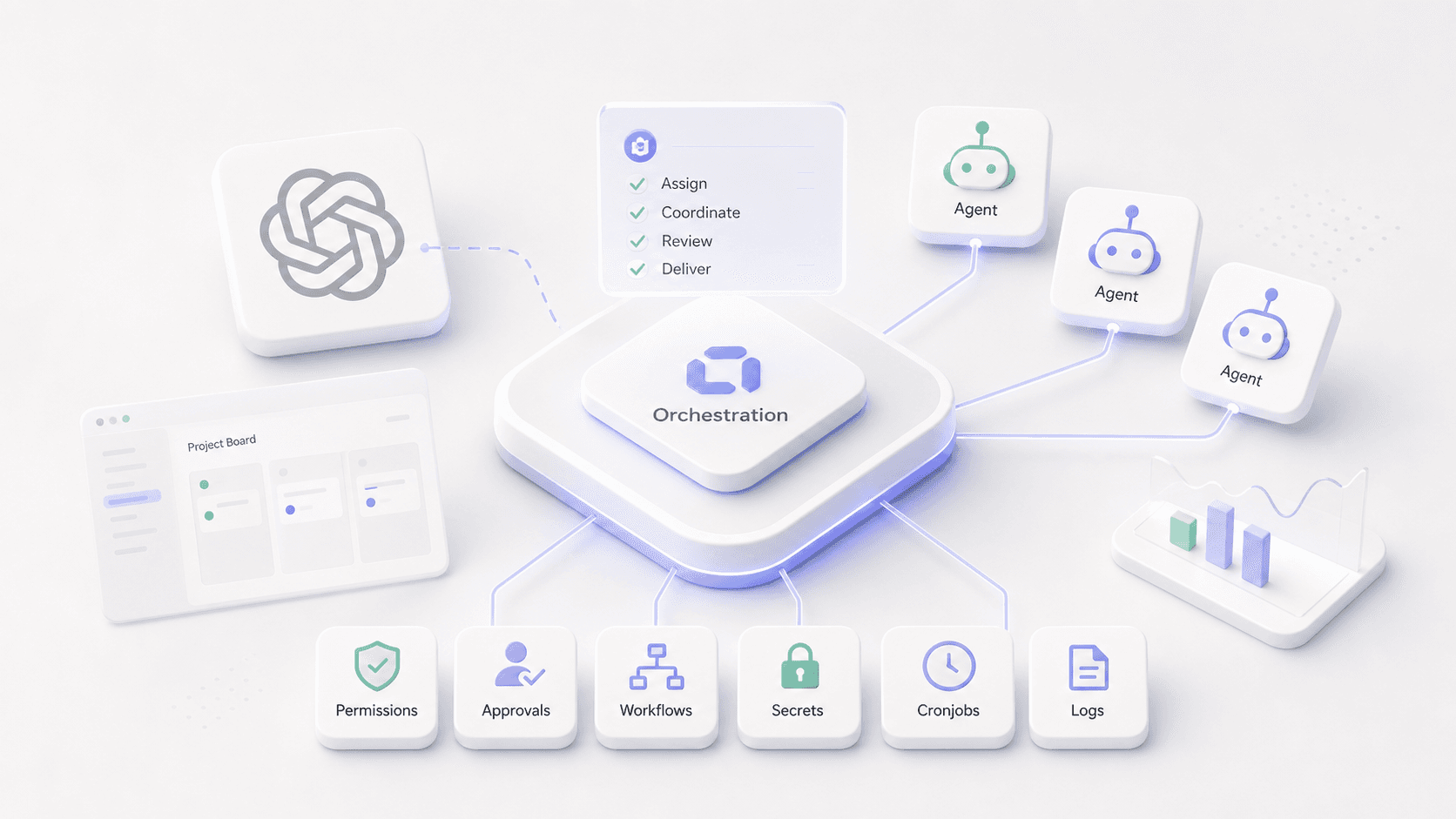
OpenAI Symphony is interesting because it pushes the conversation past single-agent coding and into orchestration.
That matters because most teams do not actually have a prompt problem. They have a coordination problem. Once you have more than one agent, the hard part is not getting code out of the model. It is deciding who does what, what they can touch, when a human has to review, and how to keep the whole thing from turning into noise.
Symphony is OpenAI’s answer to that problem. TeamCopilot takes the same problem from a different angle.
What Symphony is
InfoQ’s coverage of OpenAI’s announcement says Symphony is an agent orchestrator built around project boards and issue trackers. The idea is simple enough: instead of a developer babysitting several live coding sessions, Symphony watches the board, assigns work, restarts stalled tasks, and keeps the loop moving. OpenAI also says it is a reference implementation, not a standalone product. That detail matters.
So Symphony is a model for orchestration, not a finished team product.
Addy Osmani’s write-up on multi-agent coding lands in the same place from a different angle. The developer is no longer just the person typing into one agent. They are coordinating a team of agents. That is the right mental model here.
Where TeamCopilot fits
TeamCopilot is built for the layer around the agents: permissions, shared skills, workflows, approvals, cronjobs, secret handling, and a UI the whole team can actually use.
That is the gap Symphony does not try to solve on its own. A spec for orchestration is useful, but a team still needs a place to run agents safely, share reusable instructions, manage access, and keep non-technical teammates in the loop.
If you want a deeper look at that control layer, our post on AI Agent Governance Is the New Enterprise Control Plane covers the broader pattern. If secrets are the main concern, Why Your AI Agent Should Never See Your API Keys is the right companion read.
Symphony vs TeamCopilot
| Area | OpenAI Symphony | TeamCopilot |
|---|---|---|
| Main job | Orchestrate coding agents across tasks | Give teams a shared AI agent with governance |
| Product shape | Reference implementation / orchestration spec | Full team product |
| Core strength | Task scheduling and multi-agent flow | Permissions, workflows, secrets, approvals |
| User experience | Developer-first orchestration model | Shared web UI for teams |
| Best fit | Teams building their own orchestration layer | Teams that want to use AI safely every day |
In plain terms, Symphony shows what an orchestration layer can look like. TeamCopilot gives you the layer your team can use without building it first.
Why this matters now
OpenAI didn’t invent this direction, but it is leaning hard into it. The same theme is showing up across the market. GitHub has been talking about AI agent orchestration as a control layer. Open-source and commercial tools are all converging on the same idea: once agents can act, you need guardrails, state, and oversight.
That is also why comparisons like LiteLLM Agent Platform vs TeamCopilot are useful. They show that the agent stack is separating into layers. Some tools solve runtime. Some solve orchestration. Some solve governance. Some, like TeamCopilot, are trying to make the whole thing usable across a team.
This is the shift:
- one agent is a helper
- a team of agents is a system
- a system needs a control plane
What Symphony gets right
Symphony gets the direction right. It understands that teams do not want to babysit individual sessions forever. It also gets that agent work should be organized around tasks, tickets, and milestones instead of a single chat window.
That’s a real step forward.
It also lines up with the broader pattern Addy Osmani described: the future of agentic coding is not one clever assistant, it is a coordinated agent team with quality gates. That is where the value starts to compound.
What TeamCopilot adds on top
TeamCopilot focuses on the stuff that breaks first in real teams.
Who can run the agent? What can it access? Can a teammate reuse a working skill instead of re-explaining the same workflow every time? Can you put approvals in front of risky actions? Can you schedule recurring automation with cronjobs? Can you keep secrets out of the model’s hands?
Those are not side features. They are the product.
That is also why the comparison matters to buyers. Symphony is a strong signal that orchestration matters. TeamCopilot is the answer when you need orchestration plus the day-to-day team layer around it.
Which one should you care about?
If you are building your own orchestration infrastructure, Symphony is worth studying.
If you want a team-ready product with governance, shared usage, reusable workflows, and a safe place to put AI into daily work, TeamCopilot is the more direct answer.
For most teams, the question is not whether agents will be orchestrated. It is who gets to control them, how safely they can act, and how much manual work you still want to keep.
That’s the part we care about.
Further reading
- AI Agent Governance Is the New Enterprise Control Plane
- Why Your AI Agent Should Never See Your API Keys
- LiteLLM Agent Platform vs TeamCopilot
- How to Use Claude Code with a Team: Shared Context, Permissions, and MCP
FAQ
What is OpenAI Symphony?
OpenAI Symphony is an agent orchestrator that coordinates coding agents around tasks and project-management tools. It is closer to a reference model for orchestration than a finished team product.
Is Symphony the same thing as TeamCopilot?
No. Symphony is about orchestrating coding agents. TeamCopilot is about giving teams a shared AI agent layer with permissions, approvals, reusable skills, workflows, and a usable interface.
Why compare Symphony to TeamCopilot at all?
Because they sit in the same market shift. Both point to the same conclusion: single-agent chat is not enough for serious team work. You need orchestration and control.
Is Symphony only for developers?
From the material OpenAI and InfoQ described, Symphony is developer-centric and centered on coding tasks. TeamCopilot is broader because it is designed for shared team use, not just engineering sessions.
What does TeamCopilot add that a raw orchestration layer does not?
It adds the practical pieces teams need every day: access control, secret management, approvals, shared workflows, cronjobs, and a web UI that is not just for builders.
Do I need both?
Usually not. If you are building infrastructure, you may study Symphony. If you want to use AI safely across a team, TeamCopilot is the faster path.
Is multi-agent orchestration actually useful for small teams?
Yes. Small teams often feel the pain first because they don’t have spare capacity for manual coordination. Orchestration helps when one person is already juggling too many moving parts.
How do I keep agent work safe?
Use least privilege, approvals, logs, and secret isolation. If you want a deeper breakdown, start with Why Your AI Agent Should Never See Your API Keys.
What should I read next if I want the bigger picture?
Read AI Agent Governance Is the New Enterprise Control Plane first, then LiteLLM Agent Platform vs TeamCopilot. Those two posts explain the stack around Symphony pretty well.
Support the project
If this was useful, star TeamCopilot on GitHub.
TeamCopilot is a shared AI agent for teams with centralized context, permissions, and workflows.