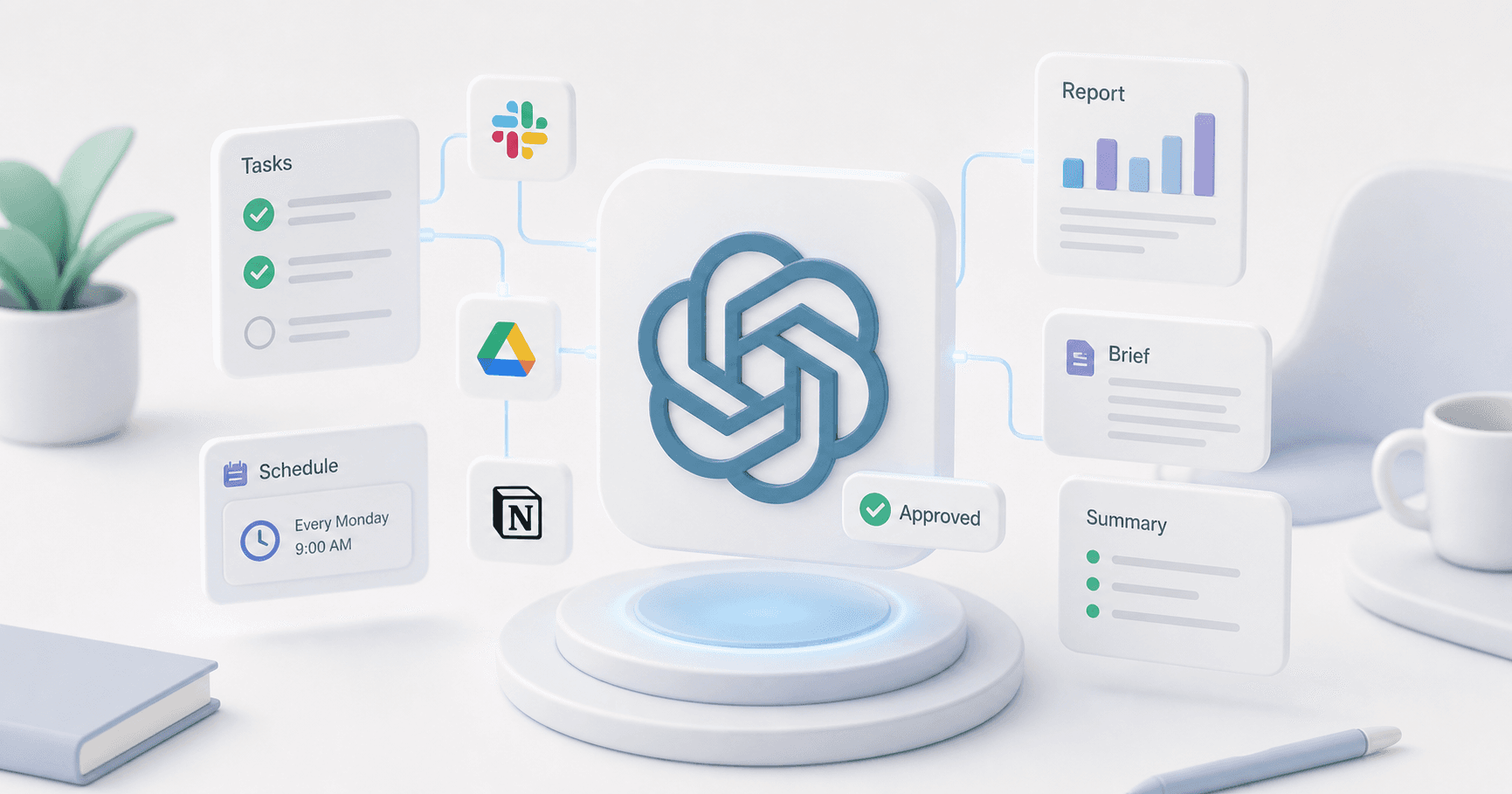
OpenAI's ChatGPT Work is a clear signal of where the market is heading. The company is now focusing on task execution, building tools that do the actual work people need done. According to Reuters, ChatGPT Work can execute tasks across different applications and files. OpenAI's release notes add that it can research information, generate various document types, and ask for approval before taking critical actions. It also supports Scheduled Tasks, allowing the agent to run once, repeat on a schedule, or monitor for changes. This update highlights how the AI race is centering on workplace execution rather than just chat interfaces.
What OpenAI actually launched
OpenAI launched ChatGPT Work on July 9, 2026, alongside GPT-5.6, aiming to give ChatGPT the context and capability to finish tasks rather than just discuss them.
According to Reuters, ChatGPT Work pulls context from connected apps and files to produce various document types. OpenAI's release notes highlight that users can guide the agent's progress in real time while retaining the ability to approve critical actions before they occur.
This approval mechanism is crucial. While most attention focuses on the final output, the real challenge lies in managing boundaries and permissions, ensuring the agent uses the correct files and stays within its designated workspace.
Why this matters
This shift moves enterprise AI from a simple demo to a practical operating model. While AI has long saved time on writing and research, the real change occurs when a tool can independently gather context, execute a workflow, and deliver a finished draft for review.
This capability changes the workday and introduces new risks. When agents act across multiple apps, teams must manage permissions, approvals, auditing, and rollbacks. This makes practical governance strategies, like those discussed in AI Agent Governance Is the New Enterprise Control Plane and Why Your AI Agent Should Never See Your API Keys, essential.
OpenAI's broader enterprise strategy reflects this. Their new consulting arm showed that implementation, not raw model access, is the real bottleneck. ChatGPT Work is the product version of that realization.
The part teams should pay attention to
There are two ways to view ChatGPT Work. The optimistic view is that it simplifies office tasks by letting an agent gather inputs and draft reports in one step. The practical view is that shared AI requires strict governance.
While a single person using ChatGPT Work to draft a memo is straightforward, coordinating ten people across three departments for recurring work introduces complex challenges. Teams must determine who has execution authority, which workflows require manual approval, where credentials are safely stored, how to reuse successful processes, and how to audit past agent actions. Product announcements typically overlook these operational hurdles.
Where teamcopilot.ai fits
teamcopilot.ai is built to make workplace agents usable and safe across an entire team by managing permissions, approvals, reusable skills, scheduled tasks, secrets, and audit trails. The critical factor is not just whether an agent can perform a task, but whether a team can run it safely, repeat it consistently, and audit it later.
As discussed in LiteLLM Agent Platform vs TeamCopilot, the market is quickly splitting into runtime, orchestration, and governance layers. While ChatGPT Work handles the execution layer, teamcopilot.ai operates at the team layer above it, providing the necessary control structure.
What to expect next
OpenAI will likely expand ChatGPT Work to more apps, new surfaces, and automated tasks. While that is the obvious direction, the harder question is whether companies will trust a single assistant with critical tasks without a structured control layer. The next wave of enterprise adoption will not be decided by flashy demos, but by who can make these agents reliable, reviewable, and safe enough for daily team use.
FAQ
What is ChatGPT Work?
ChatGPT Work is OpenAI's workplace-focused agent inside ChatGPT. It is designed for longer tasks involving connected apps, files, and multi-step outputs across various document types.
How is ChatGPT Work different from normal ChatGPT?
Normal ChatGPT answers prompts, whereas ChatGPT Work is designed to carry tasks forward, utilize connected context, and produce structured, autonomous work.
Does ChatGPT Work require approval for actions?
Yes, OpenAI says users can approve important actions as the agent works, keeping humans in the loop for higher-risk steps.
Can ChatGPT Work run on a schedule?
Yes, Scheduled Tasks can run once, repeat on a schedule or trigger, or monitor for changes.
Which users got access first?
Reuters reported that rollout began with Pro, Enterprise, and Edu users, with Plus and Business following shortly after.
Why does ChatGPT Work matter for enterprise AI?
It shows the market is moving beyond chatbots and into operational work. The next competition will focus on making agents useful inside actual business workflows rather than just improving model quality.
Is ChatGPT Work enough on its own for a team?
Probably not, as a team usually requires permissions, approvals, logging, shared workflows, and secret isolation to run agents safely.
How does this relate to teamcopilot.ai?
teamcopilot.ai helps teams run AI safely across shared workflows. If ChatGPT Work is the agent executing the task, teamcopilot.ai is the layer that controls access, permissions, and reuse.
What should companies watch before adopting tools like this?
Companies should evaluate access control, auditability, app permissions, secret handling, and whether the agent's workflows can be standardized and reused.
Is this just another productivity feature?
No, it is a sign that AI products are shifting from suggestion engines to task execution engines, representing a major category shift.
What is the biggest risk with workplace agents?
The biggest risk is granting too much access too early. Without controlled workflows, a helpful assistant can quickly become a security or operational hazard.
What is the practical takeaway for teams?
Use workplace agents where they save real time, but implement a proper control layer to ensure repeatable value instead of isolated experiments.
Support the project
If this was useful, star TeamCopilot on GitHub.
TeamCopilot is a shared AI agent for teams with centralized context, permissions, and workflows.