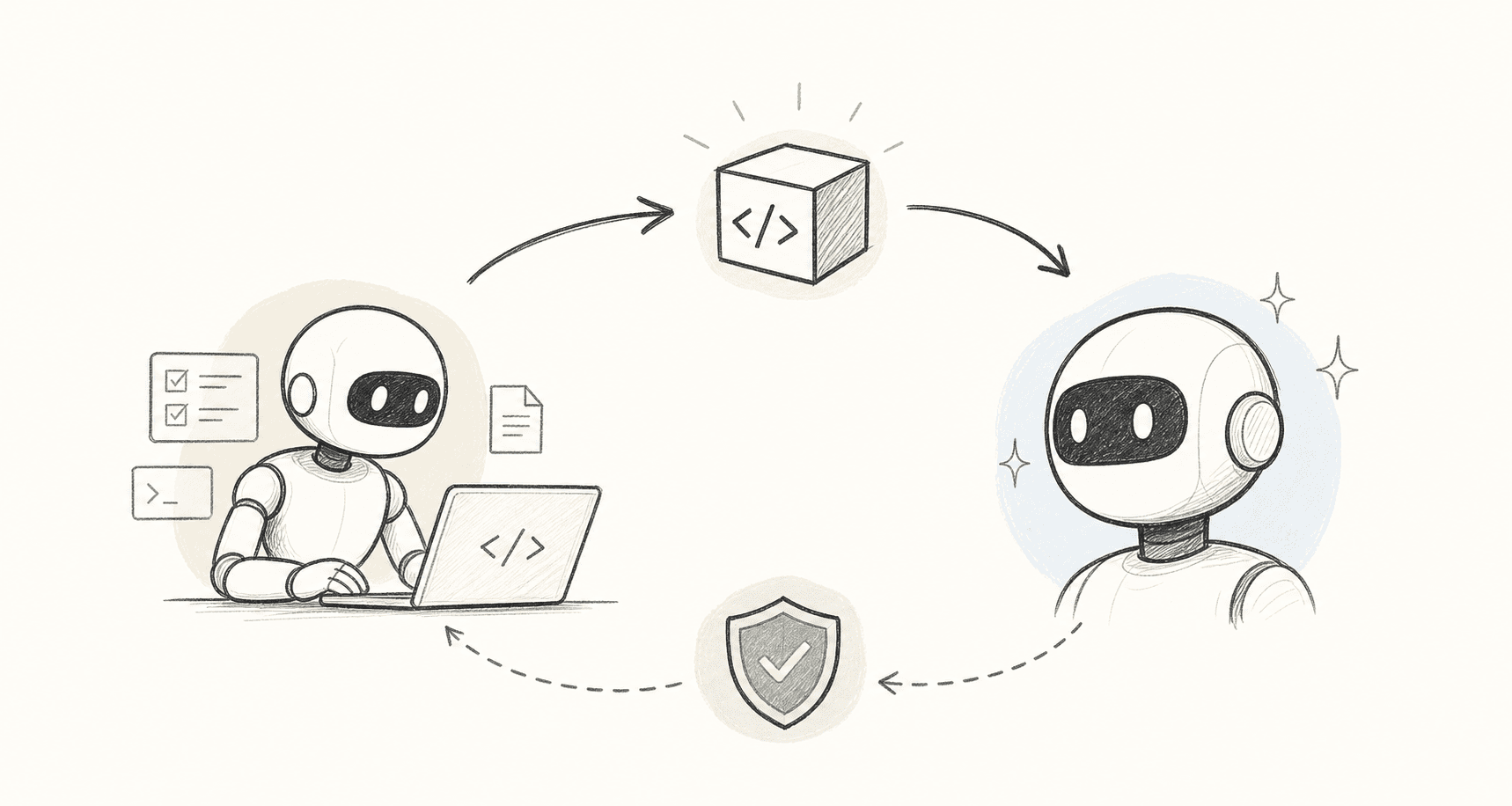
Anthropic's new essay on recursive self-improvement sounds abstract at first, but it becomes concrete when compared to daily AI engineering practices.
Today, coding agents write files, run tests, inspect logs, and execute long tasks with minimal supervision. This capability has already transformed development workflows. Anthropic suggests this is just the beginning: if models keep improving at this pace, they may eventually help build their own successors.
This shift matters because it changes what we need from the software surrounding the model, rather than just sounding like science fiction.
What Anthropic is saying
The core argument is simple: AI is accelerating its own development. Engineers use AI to write code, run tests, and offload more of the development loop to the model. Anthropic argues that this compounding cycle could continue until the model is helping with the work while also contributing to the creation of its own successor.
The post is cautious. It does not claim this outcome is guaranteed or that the loop is already closed. Instead, it highlights a real trend and a fast pace, suggesting we are underprepared for the consequences if this trajectory continues.
This is a realistic assessment.
Why this matters now
Much of the industry still focuses on raw capability. Better reasoning, benchmarks, cost, and context matter, but raw capability is only part of the equation.
The more significant shift is the transition from answer generation to task execution. Models no longer just produce text; they interact with code, tools, files, and systems. This shift changes the central question from "Is the model smart enough?" to "Can we trust the environment around it?"
This is where teams feel the pressure. A model that writes code is helpful, and one that executes long chains of tasks is even better, but an autonomous model operating without clear rules is a liability.
If you have read Coding Agent Best Practices: How to Set Up AI Agents Securely and Productively, this concept will be familiar. Useful agents require boundaries, and recursive self-improvement simply raises the stakes.
The real bottleneck is control
While Anthropic focuses on capability, the practical challenge is control. As AI systems improve at building software, we must decide what they can access, what they can modify, and how humans intervene when errors occur.
Teams already face this exact challenge with code agents, workflow automation, and shared copilots. A fast system is only valuable if it avoids making rapid, critical mistakes.
AI Agent Governance Is the New Enterprise Control Plane remains highly relevant because identity, permissions, approvals, logging, and rollback paths are essential for keeping agents predictable.
The same logic applies to credentials. If a model has access to sensitive data, it will eventually misuse it. This is why Why Your AI Agent Should Never See Your API Keys remains critical. As models grow more capable, exposing raw credentials becomes increasingly indefensible.
What this means for teams
Instead of panicking about recursive self-improvement, teams should focus on their AI stack.
If your team is already using coding agents, focus on establishing cleaner boundaries.
- Keep secrets out of the model's direct line of sight.
- Require approvals for high-risk actions.
- Separate experimental coding from production environments.
- Audit what the agent did and why.
- Treat shared workflows as infrastructure rather than simple prompts.
Managing workflows as infrastructure is critical. Once you establish repeatable AI tasks, the value lies in a secure, reusable system rather than individual prompts.
TeamCopilot provides this structure by running agents with defined permissions, workflows, and credential handling. This prevents sessions from becoming open-ended experiments and prepares teams for a future of highly capable, autonomous models.
The interesting part is not the headline
Headlines focus on AI eventually building itself, but the deeper story is how AI is already changing how we build software around it.
Anthropic shows that the model development loop is becoming automated. This shift requires businesses to build systems that support increased autonomy without sacrificing oversight.
This perspective pairs well with An AI Coding Agent Deleted a Production Database. Here's What Happened and How to Prevent It. One post explores the long-term direction of the technology, while the other shows what happens when control fails in the short term.
For a practical team perspective, How to Use Claude Code with a Team: Shared Context, Permissions, and MCP explains how to implement shared AI tools safely without granting them unrestricted access.
A practical take
We should neither dismiss recursive self-improvement as impossible nor assume it is imminent.
The practical approach is to prepare for highly capable agents by establishing guardrails today. This means implementing tighter permissions, structured workflows, smaller blast radiuses, and less reliance on raw prompts.
If AI development continues on this trajectory, the winners will be the teams that adopt new capabilities without giving up control.
FAQ
What is recursive self-improvement?
It is the process where an AI system helps design and build its successor, creating a compounding loop of development.
Is Anthropic saying this is already happening?
No. The post argues that the industry is heading in this direction, but the loop is not yet fully closed.
Why should a standard product team care?
The capabilities enabling self-improvement also make everyday coding agents much more powerful. This increases development speed but introduces significant operational risks if left unmanaged.
Does this mean we should slow down AI agents?
Not necessarily. While frontier labs face broader policy questions, most product teams simply need to focus on safer deployment by putting the right controls around their agents.
What is the biggest risk for businesses?
Uncontrolled access. If an agent can access credentials, modify production systems, or execute actions without approval, the potential blast radius is massive.
How does this connect to AI governance?
Recursive self-improvement increases the need for governance. As these systems become more capable, teams must know who can run them, what they can touch, and how they are audited.
How can teams prepare now?
Establish strict permissions, manage credentials securely, require approvals, and define clear workflows. Keep agents productive without granting them unrestricted access.
Where should I read next?
For security guidance, read Why Your AI Agent Should Never See Your API Keys. You can also explore AI Agent Governance Is the New Enterprise Control Plane to understand the operating model, or check out Coding Agent Best Practices: How to Set Up AI Agents Securely and Productively for practical team workflows.
Where does TeamCopilot fit in this picture?
TeamCopilot helps teams deploy shared AI safely. It provides the permissions, approval gates, credential management, and repeatable workflows that increasingly capable agents require.
Support the project
If this was useful, star TeamCopilot on GitHub.
TeamCopilot is a shared AI agent for teams with centralized context, permissions, and workflows.